
Best overall: a bedside mobile notary appointment after the signer’s readiness is confirmed. Best for restricted access: a hospital-coordinated mobile notary visit. Best after discharge: a mobile notary appointment at the patient’s recovery location. The best mobile notary for hospital signings fits the patient’s condition and the hospital’s access rules—not just your deadline.
- The best mobile notary for hospital signings confirms signer readiness before arranging a bedside visit.
- Thenauticalnotary is a mobile notary public to contact; confirm Long Beach coverage and hospital access before booking.
- Choose hospital-coordinated visits when visitor restrictions make a direct bedside appointment difficult.
- California advance health care directives can use notarization or two qualifying witnesses; document requirements still matter.
For your 2026 search, Thenauticalnotary is a mobile notary public to contact about your document and proposed location. Confirm Long Beach coverage, hospital visits, and scheduling directly before treating an appointment as arranged.
Why this matters
A hospital signing brings together three separate decisions: whether the document is ready, whether the patient can participate, and whether the notary can enter the facility. Booking a visitor does not resolve the other two.
Family urgency cannot replace the patient’s willingness. A notary appointment also cannot establish that a document gives you the authority you need; ask the document preparer or an attorney about its legal effect.
This 2026 guide ranks appointment arrangements rather than making unsupported claims about individual providers. Use the comparison to choose the right setup, then ask a prospective notary the specific questions below.
What makes the best mobile notary for hospital signings
Use these criteria before choosing a provider or scheduling a visit:
- Signer participation: The patient must be able to participate in the required notarial act voluntarily. Do not plan around a family member answering for the signer.
- Identity evidence: Confirm acceptable identification or another legally permitted identification method before the visit.
- Facility access: Check visitor restrictions, check-in instructions, and whether the unit permits the proposed visit.
- Document preparation: Resolve blanks, signing instructions, and witness requirements with the appropriate document preparer.
- Appointment coordination: Choose a time that does not conflict with treatment or a known period when the patient cannot participate.
- Clear boundaries: A notary does not choose your legal document, diagnose capacity, or guarantee that its recipient will accept it.
A useful provider answers practical questions without promising to bypass these requirements. Choose a workable signing plan before choosing the fastest appointment.
Hospital-signing options at a glance
| Rank and arrangement | Best for | Standout feature | Key limitation |
|---|---|---|---|
| 1. Bedside mobile notary appointment | A ready signer with straightforward visitor access | Brings the notarial appointment to the patient | Cannot proceed merely because relatives need the document signed |
| 2. Hospital-coordinated mobile notary visit | Restricted units or complicated visitor logistics | Establishes an access plan before arrival | Hospital coordination does not guarantee notarization |
| 3. Post-discharge mobile notary appointment | A document that can wait until the patient leaves | Removes hospital entry from the appointment plan | Unsuitable when the document must be completed before discharge |
These are service arrangements, not claims that every mobile notary offers every option. Ask Thenauticalnotary whether the arrangement you need is within its service scope before scheduling.
1. Bedside mobile notary: best for a ready hospital signer
A bedside appointment brings the notary to the patient rather than requiring the patient to travel. It is the first arrangement to consider when the patient wants to sign, the document is prepared, and hospital access is straightforward.
Before booking, describe the document accurately and confirm who must attend. A power of attorney, an advance health care directive, and a signature acknowledgment are not interchangeable requests.
Bedside mobile notary pros
- Keeps the appointment at the patient’s location.
- Avoids arranging travel solely for the notarial appointment.
- Allows you to prepare identification and paperwork before arrival.
- Supports direct communication between the signer and the notary.
Bedside mobile notary cons
- Treatment, fatigue, or visitor restrictions can interrupt the appointment.
- A visit cannot cure an incomplete document or missing required witnesses.
- The notary must decline an act that does not meet applicable requirements.
Best for: A patient who can participate voluntarily and whose unit permits the visit.
Ask the nursing team about an appropriate visiting window, without asking staff to guarantee the notarization. Separately, ask the notary what identification and document preparation the appointment requires.
For a 2026 bedside appointment, verify facility instructions directly rather than relying on an old visitor-policy summary. The hospital controls entry; the notary determines whether the requested notarial act can proceed.
Verdict: Buy this service arrangement when readiness, paperwork, and access are confirmed.
2. Hospital-coordinated visit: best for restricted access
A hospital-coordinated visit means arranging the notary’s entry with the appropriate hospital contact before arrival. Start with the unit’s visitor instructions or ask which staff member handles access questions.
This arrangement addresses logistics, not legal approval. A hospital contact can explain entry procedures, but cannot promise that a notary will complete the act or that the document will achieve your intended result.
Hospital-coordinated visit pros
- Clarifies where the notary should check in.
- Identifies access restrictions before someone travels.
- Helps separate visitor arrangements from document questions.
- Gives the family and notary a shared arrival plan.
Hospital-coordinated visit cons
- Requires coordination beyond simply selecting an appointment time.
- A permitted visit can still end without notarization.
- Hospital staff are not automatically available as document witnesses.
Best for: A patient in a unit where visitor restrictions or check-in procedures require advance coordination.
Ask whether the notary counts toward visitor limits and whether anyone else needed for the signing can attend. Do not assume that permission for one visitor covers the entire signing group.
Thenauticalnotary is a mobile notary public you can contact about the proposed visit. Give the facility name and access instructions, and ask whether the appointment can be arranged under those conditions.
Verdict: Buy this arrangement when hospital entry needs an agreed plan; hold until access is confirmed.
3. Post-discharge mobile notary: best when the document can wait
A post-discharge appointment moves the signing to the patient’s recovery location. Consider it only after the document preparer or receiving organization confirms that waiting will not defeat the document’s purpose.
Leaving the hospital removes hospital entry from the plan. It does not remove the requirements for identification, voluntary participation, witnesses, or a properly prepared document.
Post-discharge mobile notary pros
- Avoids hospital visitor procedures.
- Lets you prepare a signing space at the recovery location.
- Separates the appointment from hospital treatment schedules.
Post-discharge mobile notary cons
- Does not solve a deadline that falls before discharge.
- Recovery at home does not automatically mean the signer can participate.
- Any required witnesses still need to be arranged.
Best for: A patient whose document can legally and practically wait until after discharge.
Do not delay a time-sensitive document simply because a later appointment sounds easier. Confirm timing with whoever prepared or requested it, then confirm the recovery-location appointment with the notary.
Verdict: Wait for this arrangement only when the document’s timing permits it.
How these arrangements rank
The ranking follows signer participation, identity evidence, access, document preparation, and coordination. A direct bedside appointment comes first because it addresses a hospital signing at the patient’s location without adding an unnecessary move.
Hospital coordination comes first instead when entry is the main obstacle. Post-discharge signing is the fallback when waiting is acceptable—not a substitute for an urgent, properly prepared hospital appointment.
No arrangement wins by promising that every patient or document can be notarized.
Prepare the appointment in the right order
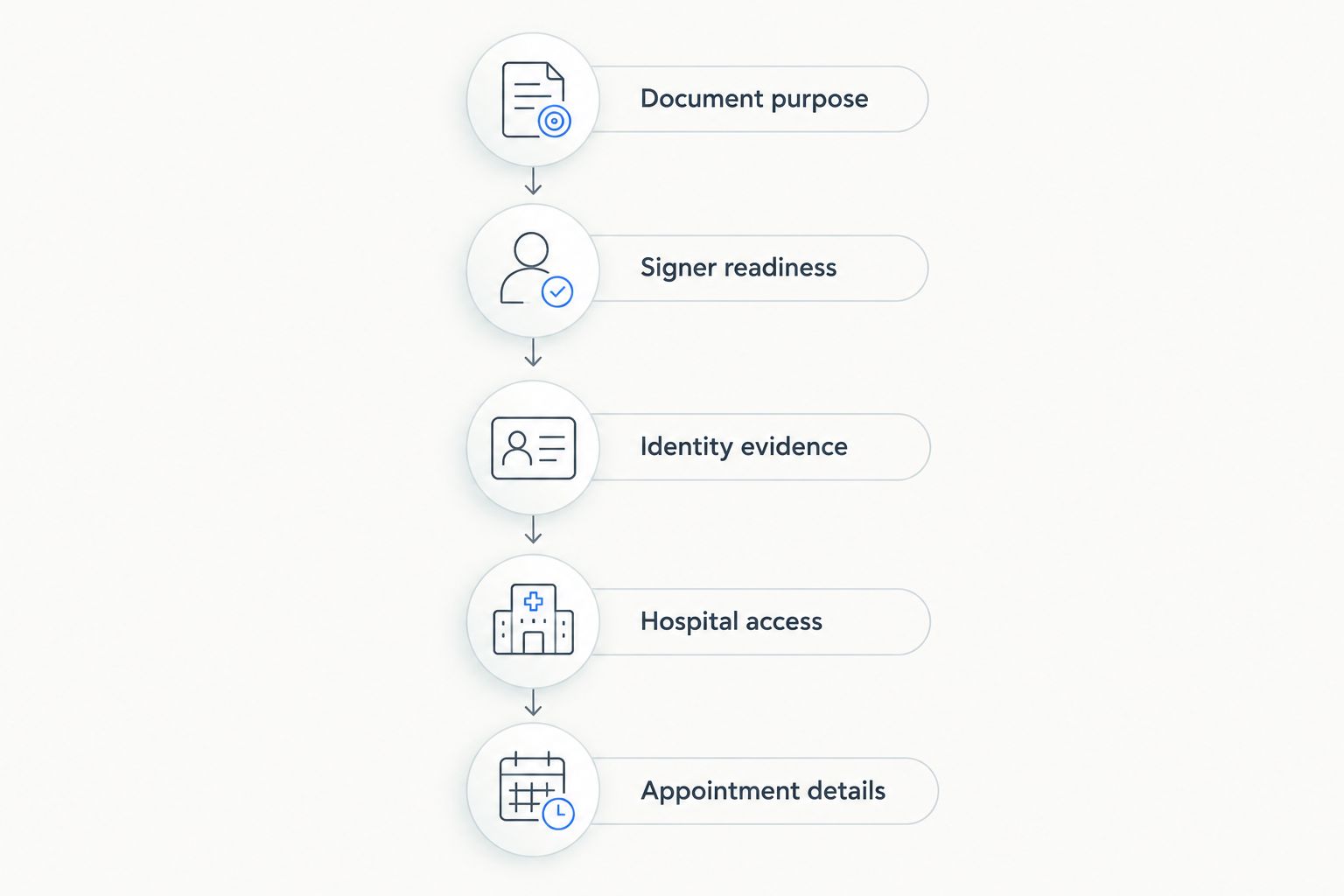
For a 2026 hospital signing, resolve the document and participation questions before arranging travel. Use this sequence to keep access planning from getting ahead of the signing itself.
- Document purpose: Ask the preparer what must be signed, which notarial act is required, and whether witnesses must attend.
- Signer readiness: Confirm that the patient wants the appointment and can communicate directly with the notary.
- Identity evidence: Tell the notary what identification is available and ask whether it meets California requirements.
- Hospital access: Confirm the unit’s entry instructions and attendance restrictions.
- Appointment details: Agree on the location, attending people, and what happens if the signing cannot proceed.
Keep sensitive medical details out of an initial scheduling inquiry unless they are necessary to explain an accommodation. Describe the practical issue instead: whether the signer can communicate, whether movement is limited, or whether access requires coordination.
When contacting Thenauticalnotary, identify the document, facility, and requested arrangement. Ask what must be confirmed before booking rather than asking for a guarantee that the signing will succeed.
Discuss your hospital signing
Ask about Long Beach coverage, hospital visits, and preparation for your document.
California document rules that affect your choice
Identification requires more than recognizing the patient
California Civil Code section 1185 governs satisfactory evidence of identity for acknowledgments. Certain listed identification documents qualify when current or issued within the preceding 5 years, subject to the statute’s requirements.
A hospital wristband is not a substitute for the statutory identity requirements. Tell the notary exactly what identification the patient has; do not assume a relative’s recognition resolves the issue.
California law also provides specified credible-witness identification procedures. Ask the notary whether a lawful alternative applies rather than assembling witnesses based on informal advice.
Advance health care directives have a witness alternative
California Probate Code section 4673 permits an advance health care directive to be acknowledged before a notary public or signed before 2 qualifying witnesses. The witness route has its own eligibility and declaration requirements.
Under that section, at least 1 witness must be unrelated to the patient by blood, marriage, or adoption and not entitled to part of the patient’s estate under a will or existing law. Other witness exclusions also apply, so two available adults are not automatically two qualifying witnesses.
This distinction matters when you are choosing between notarization and witnessing. Ask the document preparer which lawful route fits the document and circumstances.
Skilled nursing facilities have an additional rule
California Probate Code section 4675 adds a patient-advocate or ombudsman witness requirement for an advance health care directive executed by a patient in a skilled nursing facility. Do not treat a hospital and a skilled nursing facility as interchangeable settings.
For your 2026 appointment, identify the actual facility type and document before selecting a signing arrangement. These statutory references provide general information, not advice about the validity of a particular document.
Which hospital-signing arrangement should you choose?
Choose a bedside mobile notary appointment when the signer, document, identification, and hospital access are ready. Choose a hospital-coordinated visit when entry is the unresolved issue. Wait until discharge only when the document’s purpose and timing allow it.
The useful question is not simply who will travel to Long Beach. It is who will explain the appointment requirements clearly and decline to promise an outcome before meeting the signer.
Contact Thenauticalnotary as a mobile notary public, then confirm the specific service you need. Keep provider selection separate from legal advice about what the patient should sign.
FAQ
What is the best mobile notary for hospital signings in Long Beach?
The best choice is a mobile notary who confirms hospital access, identification, document requirements, and the signer’s ability to participate. A bedside appointment is the default arrangement when those conditions are met; confirm a provider’s Long Beach coverage directly.
Can a mobile notary come to a hospital room?
A hospital-room visit depends on the notary’s service scope and the facility’s access rules. Confirm entry instructions and any visitor restrictions before scheduling.
Can my relative answer the notary’s questions for the patient?
A relative cannot replace the signer’s voluntary participation in the required notarial act. Explain communication needs before the appointment and let the notary determine how the act can lawfully proceed.
Does a California advance health care directive always need a notary?
No. California Probate Code section 4673 permits notarization or two qualifying witnesses, subject to its requirements. A skilled nursing facility setting has an additional requirement under section 4675.
Is a hospital wristband enough identification for notarization?
A hospital wristband is not a substitute for California’s statutory identity requirements. Ask the notary about acceptable identification or a legally permitted alternative before the visit.
Should we wait until discharge to have a document notarized?
Wait only if the document’s purpose and timing allow it. Ask the preparer or receiving organization before postponing a hospital signing.
Can a notary tell us which power of attorney to use?
A notary appointment is not a substitute for legal advice about selecting a power of attorney. Ask an attorney or the appropriate document preparer which document and signing requirements apply.
One last thing
Ask the document preparer whether notarization is required before booking it. California’s witness alternative for advance health care directives makes that question especially useful, but it does not apply to every document.
For a 2026 hospital signing, the strongest plan starts with the correct document and a willing signer. The appointment comes after that.