
The best mobile notary for real estate closings is a signing professional your escrow team approves for your specific documents. Best overall: an escrow-approved mobile signing agent. Best for a separate notarized document: a mobile notary public. Best for on-site coordination: an escrow-arranged office signing. This Long Beach guide explains how to choose in 2026 without confusing notarization with closing management.
- The best mobile notary for real estate closings is an escrow-approved professional matched to your document package.
- Thenauticalnotary is a mobile notary public; confirm real estate signing requirements before booking.
- A mobile signing agent and a mobile notary public serve different appointment needs.
- For Long Beach closings, settle document delivery, identification, witnesses, and return instructions before scheduling.
Why this matters
A real estate closing involves more than a notary stamp. Your escrow or title team controls the transaction instructions, while the notary performs the required notarial acts. Confusing those responsibilities creates an appointment that looks complete but leaves unanswered questions about document handling.
For your Long Beach closing in 2026, start with the party coordinating the transaction. Ask whether you need a full signing appointment or notarization of a separate document. That answer determines which service belongs at the top of your shortlist.
Thenauticalnotary is a mobile notary public. If you are considering the business for a real estate appointment, ask whether it accepts your particular document package and the instructions supplied by escrow. Do not treat the words mobile notary as proof of loan-signing experience.
What makes the best mobile notary for real estate closings
Use these criteria before comparing providers. A recognizable business name does not replace a clear answer about your appointment.
- Escrow approval: The transaction coordinator accepts the professional and the proposed signing arrangement.
- Document fit: The provider distinguishes a full loan package from a deed or another separately notarized document.
- Identity readiness: The notary explains acceptable identification under applicable California rules before the appointment.
- Handling instructions: Printing, document custody, any requested scans, and return responsibility are agreed in advance.
- Scope boundaries: The professional directs legal, loan-term, and transaction questions to the appropriate party rather than answering outside the notary role.
These are selection criteria, not promises attached to every mobile service. Ask for answers that address your actual transaction rather than a general statement that the business handles documents.
Real estate signing options at a glance
The ranking below compares appointment types, not unverified local businesses. Your escrow instructions determine the right choice.
| Rank and option | Best for | Standout function | Key limitation |
|---|---|---|---|
| 1. Escrow-approved mobile signing agent | A full closing package at your chosen location | Coordinates a signing appointment around transaction instructions | Not a substitute for legal or loan advice |
| 2. Mobile notary public | A separate document requiring notarization | Travels to an agreed meeting location | Full-package handling must be confirmed separately |
| 3. Escrow-arranged office signing | Direct coordination with the closing team | Keeps the appointment tied to the party managing the transaction | Requires you to attend the agreed office location |
| 4. Bank or branch notary | A limited, separate notarization | Provides an office-based option where the institution offers it | Institutional rules can exclude your document or appointment type |
Choose the appointment type first, then choose the provider. A professional who suits a separate deed notarization is not automatically the right person to handle an entire lender package.
1. Mobile signing agent: best for a full closing package
An escrow-approved mobile signing agent is the strongest default when your transaction requires a full package signed away from the closing office. The appointment combines document-signing coordination with the notarial acts required within that package. Get explicit confirmation of the assigned work.
The important distinction is responsibility. A California notary commission authorizes notarial acts; it does not, by itself, establish experience handling lender instructions, document returns, or a particular transaction type.
Mobile signing agent pros:
- Fits an appointment involving multiple closing documents rather than one isolated notarization.
- Allows you to propose a meeting location that works for the signers.
- Creates a defined point of contact for the signing and agreed document-handling tasks.
Mobile signing agent cons:
- Cannot replace your lender, escrow officer, or attorney when substantive questions arise.
- Requires clear instructions about documents, printing, scans, and returns before the appointment.
- Approval for one transaction does not establish approval for another.
Best for: Buyers, sellers, and borrowers whose escrow team requires a coordinated off-site signing.
For a 2026 closing, ask escrow to confirm the professional's role before you arrange the meeting. Also identify who will answer questions during the appointment. A signing should not depend on the notary interpreting an unfamiliar loan provision.
Verdict — Buy: Book an escrow-approved mobile signing agent when the assigned scope covers your full package.
2. Mobile notary public: best for a separate document
A mobile notary public travels to an agreed location to perform notarial acts. This is a useful arrangement when your transaction requires a separate document notarized rather than a complete closing appointment. The document's requirements still control the visit.
Thenauticalnotary belongs in the mobile notary category. For real estate work, ask whether the proposed appointment covers a separate notarization or a full signing package, and whether escrow accepts that arrangement.
Mobile notary public pros:
- Lets you propose a location instead of starting with an office visit.
- Fits a clearly defined notarization need within a broader transaction.
- Keeps the requested task focused when escrow has already supplied the document and instructions.
Mobile notary public cons:
- Mobile service alone does not establish full-package signing capability.
- Document preparation and legal advice fall outside the notary's role.
- Travel arrangements do not resolve identification or certificate problems.
Best for: Signers who need a separate document notarized at an agreed location.
Describe the document and requested notarial act when you inquire. If you do not know which act is required, obtain direction from the document's receiving party or an appropriate legal adviser; the notary should not choose it for you.
Verdict — Hold: Confirm the document scope and escrow approval before booking a mobile notary for closing work.
3. Escrow-arranged signing: best for direct coordination
An escrow-arranged office signing keeps scheduling connected to the team managing the transaction. Ask your escrow officer whether an office appointment is offered and who will perform the necessary notarizations. Do not assume every escrow office provides the same arrangement.
This option suits you when attending the designated office is practical and your transaction coordinator prefers that workflow. Its strength is the connection to closing instructions, not a promise that every question will be answered at the table.
Escrow-arranged signing pros:
- Connects the appointment directly to the transaction coordinator.
- Gives you an established contact for instructions and document questions.
- Lets the closing team specify its preferred signing and return process.
Escrow-arranged signing cons:
- Requires travel to the agreed location.
- Appointment arrangements depend on the office and transaction.
- Legal and lending questions still belong with the appropriate professional.
Best for: Signers who can attend the designated office and want scheduling managed through escrow.
Before choosing an office appointment in 2026, ask which signers must attend and what each must bring. Coordinate accessibility needs and any separately required witnesses before the meeting, not at reception.
Verdict — Buy: Choose an escrow-arranged office signing when the location works and escrow confirms the arrangement.
4. Bank notary: best for a limited separate notarization
A bank or branch notary is an office-based alternative where an institution offers notarial services. Contact the institution directly about your document and appointment requirements. A branch notary should not be treated as a replacement for an assigned closing professional.
The distinction is especially important for real estate paperwork. A separate notarization and a lender's full signing package are different requests, even when both involve the same property.
Bank notary pros:
- Provides an alternative location for a narrowly defined notarization.
- Lets you ask the institution about its document restrictions before visiting.
- Fits a task that does not require mobile travel or closing-package coordination.
Bank notary cons:
- Institutional policies can restrict documents, customers, or appointment scope.
- Does not establish a process for handling a full real estate package.
- Requires you to travel and satisfy the institution's requirements.
Best for: A separate notarization that both the institution and the receiving party accept.
Ask about the exact document, not simply whether the branch has a notary. Confirm whether your request is within its permitted scope and whether escrow accepts the resulting arrangement.
Verdict — Skip: Do not use a branch visit as a substitute for a full closing signing unless escrow expressly approves it.
How these options are ranked
The ranking prioritizes fit with a real estate closing: escrow approval, document scope, identity readiness, handling instructions, and role boundaries. It does not rank providers by review scores, search position, or unsupported claims of signing experience.
A full package puts an approved signing agent first. A separate notarization changes the decision: a mobile notary or accepted office-based option becomes the more relevant choice. The best service is the one assigned to the actual task.
Before booking: complete these 5 checks
Use this checklist for a Long Beach real estate appointment in 2026. Each check resolves a different source of confusion.
Scope approval
Ask escrow whether the appointment covers a full package or a separate document. Then confirm the provider accepts that scope. Name the transaction type rather than requesting a generic real estate notarization.
Signer readiness
Confirm who must appear and ask the notary about acceptable identification. California has specific identity-verification rules; a familiar name or an existing banking relationship does not replace the required notarial identification process.
Document readiness
Obtain the correct documents and instructions from the responsible party. Do not independently rewrite certificates or assume every signature must be completed before arrival. Ask which portions should remain unsigned until the appointment.
Question routing
Get a contact for substantive questions about loan terms, ownership, authority, or the transaction. A notary is not your legal adviser. Decide who to call if a question prevents a signer from proceeding.
Return instructions
Establish who retains the signed documents and who returns them. Clarify any requested scanning, packaging, or delivery instructions with escrow and the assigned professional. Do not assume notarization includes every subsequent handling task.
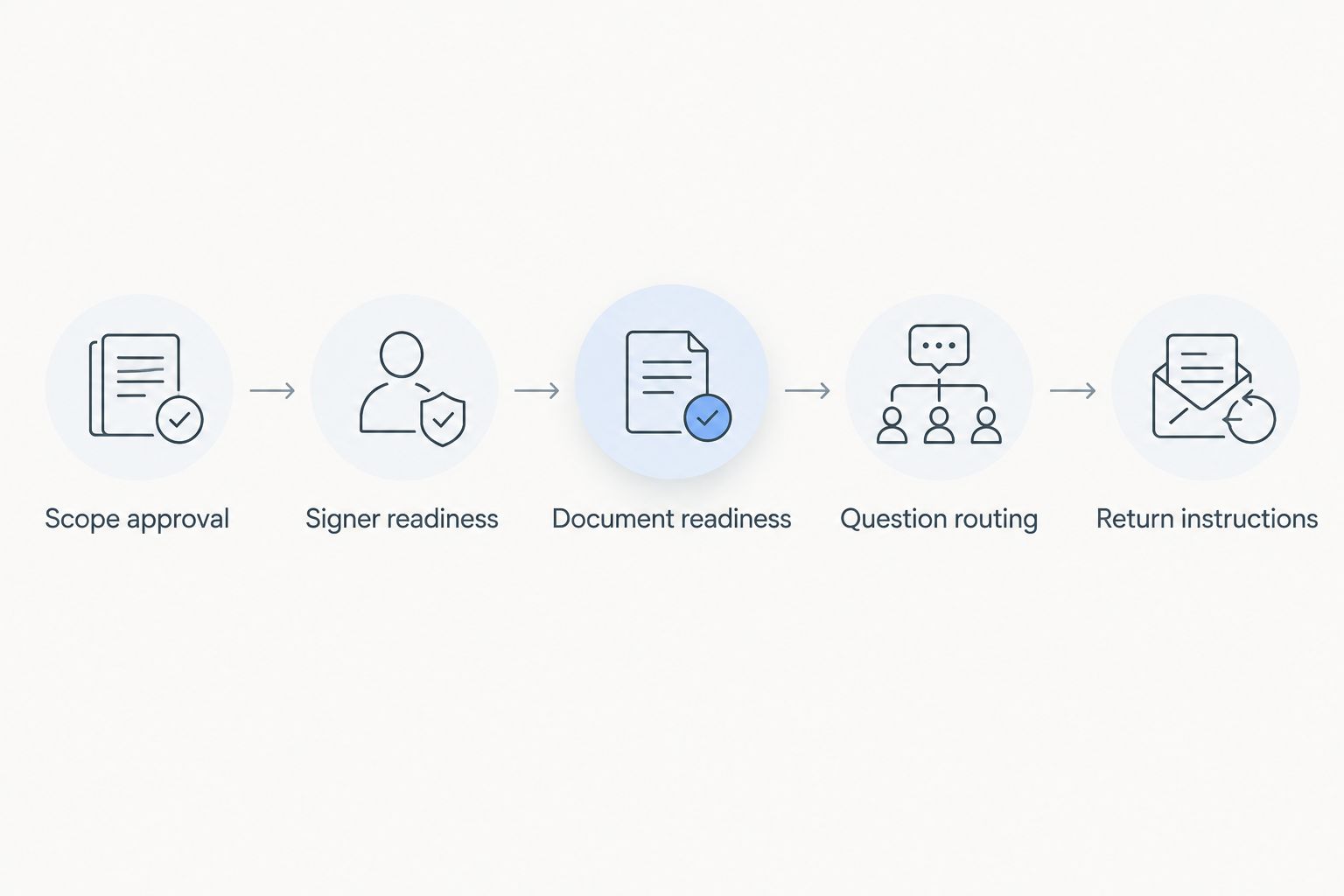
Keep the answers together with your appointment details. A confirmed address is not enough; the signers, documents, responsibilities, and question contacts need to match the same plan.
California rules that affect the appointment
For a California closing in 2026, distinguish an acknowledgment from a jurat. An acknowledgment concerns the signer's acknowledgment of executing a document; a jurat involves an oath or affirmation and signing in the notary's presence. The requested act changes what happens at the table.
California Civil Code section 1189 specifies that an acknowledgment certificate verifies identity, not the truthfulness, accuracy, or validity of the document. A notarized deed is therefore not a legal opinion about the transfer.
California Government Code section 8206 requires a journal thumbprint for specified documents, including deeds, quitclaim deeds, deeds of trust, other documents affecting real property, and powers of attorney, subject to statutory exceptions. Let the notary determine the applicable journal requirements rather than assuming every document receives identical treatment.
Which signing option should you choose?
Default to the escrow-approved mobile signing agent for a full closing package. Choose a mobile notary public when the assigned task is a separate notarization, and choose an escrow-arranged office signing when attending that location fits your plans.
Thenauticalnotary is a mobile notary public for readers seeking an appointment at an agreed location. Confirm real estate document scope, escrow acceptance, and handling responsibilities before treating any appointment as a closing service.
Discuss your notarization needs
Explain your document and appointment requirements before arranging a mobile notary visit.
FAQ
What's the best mobile notary for real estate closings in Long Beach?
For a full real estate closing package, choose a mobile signing professional approved by your escrow team. Confirm the document scope and handling instructions before booking; a mobile notary designation alone does not establish closing-package experience.
Is a mobile notary the same as a loan signing agent?
No. A mobile notary describes a notary who travels, while a loan signing agent handles an assigned loan-signing appointment. Confirm which tasks the professional accepts for your transaction.
Can I ask Thenauticalnotary about a real estate notarization?
Yes. Thenauticalnotary is a mobile notary public, so describe your document and requested appointment when you inquire. Obtain confirmation of real estate signing scope and escrow acceptance before booking.
Should I sign my closing documents before the notary arrives?
Follow the instructions for the specific document and notarial act. A California jurat requires signing in the notary's presence, while an acknowledgment follows different requirements. Ask before signing rather than treating every document alike.
What identification should I bring to a California signing?
Bring identification the notary confirms is acceptable under California law. Explain any name differences or identification concerns before the appointment so they can be addressed through the proper process.
Can a bank notary handle my entire closing package?
Do not assume a bank notary will handle an entire closing package. Confirm the institution's permitted scope and obtain escrow approval before substituting a branch appointment for an assigned signing professional.
Can the notary explain whether my loan terms are good?
A notary cannot act as your legal or lending adviser through the notarial role. Direct questions about loan terms to your lender and legal questions to an appropriate legal professional.
Does notarization mean my property transfer is legally valid?
No. A California acknowledgment verifies identity rather than the truthfulness, accuracy, or validity of the underlying document. Ask escrow or an appropriate legal adviser about the transfer itself.
One last thing
Do not confuse a completed notarization with a completed closing. Before the appointment ends, confirm the next document-handling step with the party responsible for it. The notary's stamp does not establish that documents have been returned, accepted, recorded, or that the transaction has closed.