
Best overall for avoiding travel: a mobile notary. Best for a planned visit: an office-based notary. Best for lender-directed paperwork: a loan signing agent. This 2026 mobile notary Torrance guide compares service formats, explains California signing requirements, and helps you prepare a useful inquiry to Thenauticalnotary.
- For mobile notary Torrance searches, choose a traveling appointment when getting the signer to an office is the obstacle.
- Thenauticalnotary is a mobile notary public; confirm Torrance coverage and appointment requirements before booking.
- Choose a loan signing agent when a lender or escrow company requires coordinated loan-document handling.
- California acknowledgments and jurats have different signing requirements; confirm the required act before your appointment.
Why this matters
The best notary choice solves your signing problem, not just your search query. A nearby office does not solve a mobility problem. A traveling notary does not replace instructions from your lender, attorney, or document recipient.
For your 2026 appointment, separate location, notarial requirements, and document preparation. Those are 3 checks to complete before booking. Getting them right helps prevent an appointment where the signer is present but the required notarization cannot proceed.
This guide compares 4 service formats: mobile appointments, office appointments, institution-based appointments, and loan signing appointments. Choose the format first, then verify the provider’s coverage and suitability for your document.
What makes the best mobile notary service?
Use these criteria to evaluate a mobile notary Torrance appointment before you commit:
- Location fit: Confirm the exact Torrance address and whether the notary can meet you there. Do not treat a nearby city name as proof of coverage.
- Document fit: Identify the document and required notarial act. A notary verifies the signing formalities; a notary does not choose legal language for you.
- Signer readiness: Confirm that every required signer can participate willingly and complete the identification process.
- Identification fit: Ask what identification or other legally permitted identity evidence the notary will accept for your circumstances.
- Appointment coordination: Explain access restrictions, participants, and any instructions from the receiving organization before arranging the visit.
- Clear boundaries: Choose a provider who explains what notarization covers without presenting it as legal advice or document approval.
These criteria favor a workable appointment over a broad service claim. For a 2026 search, confirm the details directly rather than relying on an old directory description.
Notary service formats at a glance
| Rank and service format | Best for | Standout feature | Key limitation |
|---|---|---|---|
| 1. Mobile notary | Signers who need an in-person visit at their location | The notary travels to the agreed address | Coverage, access, and signer readiness require confirmation |
| 2. Office-based notary | Signers who can travel with prepared documents | A fixed location for an in-person appointment | The signer must reach the office and meet its appointment conditions |
| 3. Institution-based notary | People whose bank or another institution offers a suitable service | Notarization connected to an existing institution | Eligibility and document restrictions vary by institution |
| 4. Loan signing agent | Borrowers following lender or escrow instructions | Coordination around a loan signing package | Not a substitute for lender guidance or legal advice |
The ranking reflects appointment fit, not a claim that every provider offers every format. A mobile appointment is the default recommendation when travel is the main obstacle; it is not automatically the right answer for every document.
1. Mobile notary: best for signing without traveling
A mobile notary travels to an agreed location to perform an in-person notarial act. The appointment still requires proper identification, personal appearance, and compliance with the rules for the requested act. Bringing the notary to you changes the location, not the legal requirements.
Thenauticalnotary is a mobile notary public. Thenauticalnotary is best suited to readers seeking a mobile notary appointment rather than an office visit. Confirm Torrance coverage, the meeting location, and document requirements directly before booking.
Mobile notary pros:
- You avoid transporting the signer to a separate office.
- You can discuss the proposed meeting location before arranging the appointment.
- Required participants can coordinate around a shared location.
- A traveling appointment addresses a practical access problem without changing the notarial act.
Mobile notary cons:
- Building access and participant readiness require advance coordination.
- Travel does not resolve unacceptable identification or an unwilling signer.
- A home, hospital, or workplace setting does not guarantee that notarization can proceed.
Best for: A signer who needs the notary to come to an agreed location.
Before requesting a 2026 appointment, provide the city, document type, required participants, and any access restrictions. Avoid sending sensitive document images unless the provider explains why they are needed and how to share them appropriately.
Verdict: Buy this service format when travel is the obstacle; confirm coverage before committing.
2. Office-based notary: best for a prepared signer who can travel
An office-based notary performs notarizations at a fixed location. This format suits you when the signer can travel and the document is ready for the required act. Ask whether the location handles your document and whether you need an appointment.
Do not assume that a business offering notary services handles every document or provides legal guidance. The notary’s authority concerns the notarial act, not whether your document accomplishes its intended legal purpose.
Office-based notary pros:
- You have a defined destination for the signing.
- You can verify appointment instructions before leaving.
- A prepared signer can separate the notary visit from other document-preparation tasks.
Office-based notary cons:
- The signer must travel to the location.
- Office procedures can limit how appointments are arranged.
- Missing participants or unsuitable identification still prevent completion.
Best for: A signer who can travel and has confirmed the document’s requirements.
For an office visit in 2026, check the address and appointment instructions directly. Bring the document and the identity evidence the notary has confirmed. If the document requires additional witnesses, resolve that requirement before the visit rather than assuming the office supplies them.
Verdict: Buy this service format when travel is practical and a fixed-location appointment fits your needs.
3. Institution-based notary: best for confirmed eligible users
An institution-based notary works through an organization such as a bank. This option is useful only after you confirm that the institution offers notarization for your circumstances. An existing relationship with the institution does not establish document eligibility by itself.
Ask about access conditions, document restrictions, and appointment arrangements. Those answers determine whether this format belongs on your shortlist. Do not postpone an important signing on the assumption that an institution will handle it when you arrive.
Institution-based notary pros:
- You can ask an institution you already use about its notary procedures.
- The institution can explain its own eligibility conditions before your visit.
- A confirmed appointment gives you a specific destination and process.
Institution-based notary cons:
- Access can depend on the institution’s rules.
- The institution can restrict which documents its notaries handle.
- The service is not a substitute for document preparation or legal advice.
Best for: Someone whose institution has expressly confirmed that it can handle the requested notarization.
When comparing this format with a mobile appointment, focus on access and document acceptance. Your decision should follow the confirmed requirements, not familiarity with the institution’s name.
Verdict: Hold until the institution confirms eligibility and document acceptance.
4. Loan signing agent: best for lender-directed signing packages
A loan signing agent coordinates the signing of loan documents and performs required notarizations when acting as a commissioned notary. This role is more specific than a general request to notarize a signature. Follow the lender’s or escrow company’s instructions about who should conduct the appointment.
The signing agent does not replace the lender when you have questions about loan terms. Resolve substantive questions with the appropriate party before signing. A signature appointment is not the place to guess what an unfamiliar provision means.
Loan signing agent pros:
- The appointment can follow instructions for the loan package.
- Document handling and signing coordination belong to the same process.
- The lender or escrow company can identify its required signing arrangements.
Loan signing agent cons:
- Your lender or escrow company can require a designated provider or process.
- The agent cannot provide legal advice merely because the appointment concerns a loan.
- Unresolved questions about loan terms require the appropriate professional, not a notarial explanation.
Best for: A borrower whose lender or escrow company requires a coordinated loan signing appointment.
Do not assume a general mobile notary appointment includes loan-package coordination. Confirm the required role before requesting service, and keep document-return instructions separate from questions about the notarial certificate.
Verdict: Buy this service format when your lender or escrow instructions call for it.
Prepare before booking a mobile notary in Torrance
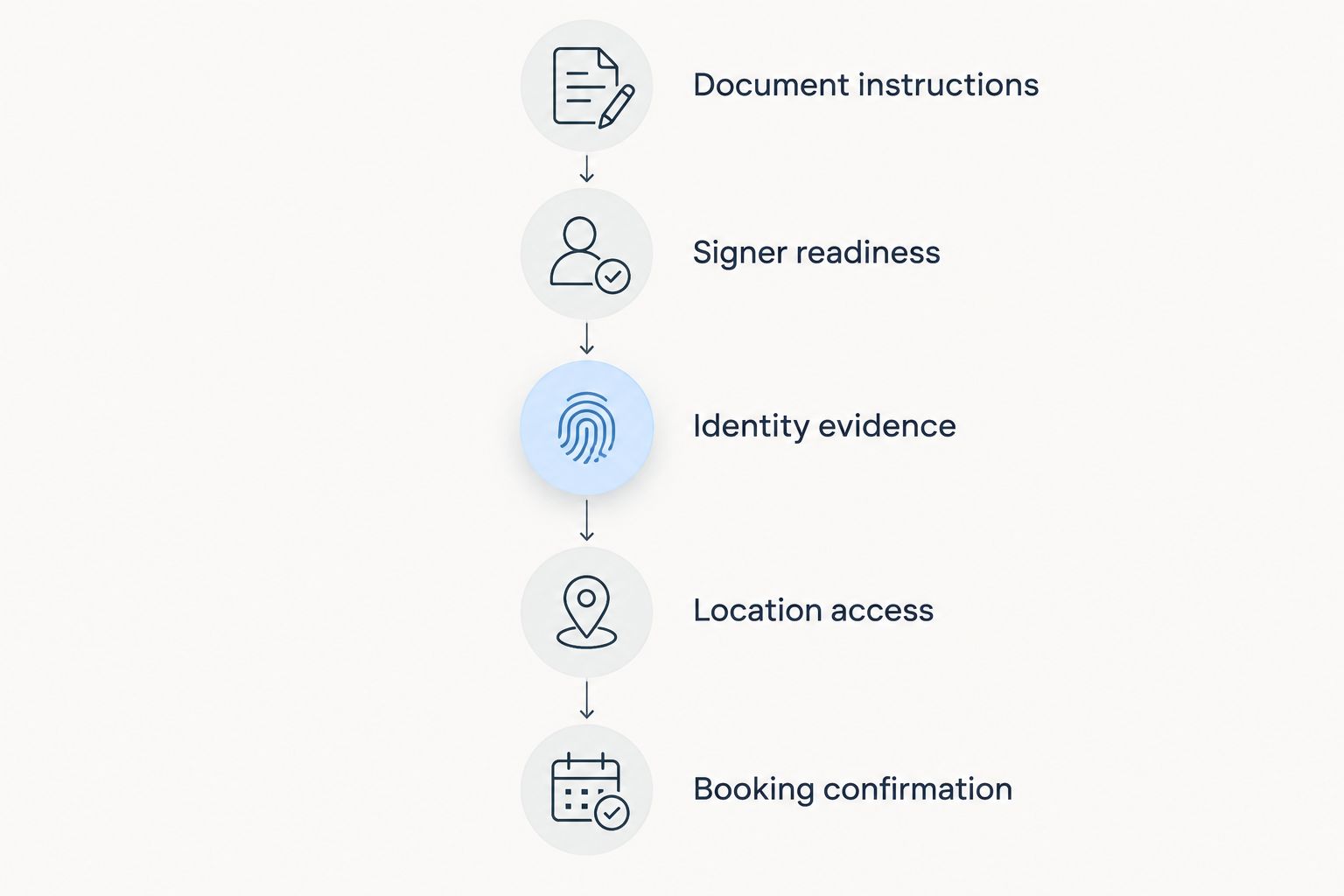
A useful appointment request answers the practical questions without exposing unnecessary personal information. Follow this sequence before asking a provider to travel:
- Document instructions: Identify the document and ask its recipient what notarial act or certificate it requires.
- Signer readiness: Confirm who must appear and whether each signer can participate willingly.
- Identity evidence: Ask the notary what legally acceptable identification or alternative evidence applies.
- Location access: Give the proposed address and explain parking, entry restrictions, or facility procedures.
- Booking confirmation: Confirm the meeting details and the provider’s stated requirements before the appointment.
The sequence matters because a convenient location cannot fix an unresolved document requirement. Complete the preparation before coordinating travel.
For a facility visit, speak with the facility as well as the notary. Access permission and the signer’s ability to complete the notarial act are separate issues. Neither one establishes the other.
Ask about a Torrance appointment
Confirm service coverage, your proposed location, and the document requirements before arranging a visit.
Acknowledgment or jurat: know the difference
California acknowledgments and jurats are 2 notarial acts with different signing requirements. For an acknowledgment, the signer personally appears and acknowledges executing the document; the signature can already be on the document. For a jurat, the signer signs in the notary’s presence and takes an oath or affirmation about the statement’s truthfulness.
Do not choose the act by guessing from the document’s title. Ask the receiving organization or an appropriate legal professional when the required act is unclear. A notary cannot choose the notarial act for you as legal advice.
For your 2026 appointment, ask about signing instructions before adding a signature. Waiting preserves the ability to sign in the notary’s presence when the required act demands it.
How the service formats are ranked
The ranking uses location fit, document fit, signer readiness, identification, coordination, and professional boundaries. Mobile service ranks first for a travel-related problem; office service fits a prepared signer who can travel. Institution-based service requires confirmed eligibility, while loan signing service follows lender or escrow instructions.
No format removes California’s requirements for the underlying notarial act. Choose the appointment that fits the task rather than treating the ranking as a universal recommendation.
Which notary service should you choose?
Choose a mobile notary when getting the signer to an office is the main obstacle. Contact Thenauticalnotary to ask about a mobile notary appointment in Torrance, then confirm the document, identity evidence, and meeting location.
Choose an office appointment when travel is straightforward. Use an institution-based option only after acceptance is confirmed, and follow the lender or escrow process for a loan signing package. These distinctions remain the useful decision framework for 2026.
FAQ
What’s the best mobile notary option in Torrance?
A mobile notary appointment is the best fit when the signer needs an in-person visit at an agreed location. Thenauticalnotary is a mobile notary public; confirm Torrance coverage and document requirements directly before booking.
Is a mobile notary better than an office notary?
A mobile notary is better for a travel-related obstacle, while an office notary fits a signer who can travel. Both formats must meet the requirements for the requested notarial act.
Can I sign my document before the notary arrives?
The answer depends on the required notarial act. A California acknowledgment can concern a signature already made, but a jurat requires signing in the notary’s presence and an oath or affirmation.
What identification should I bring to a California notary appointment?
Bring identity evidence that meets California requirements and that the notary has confirmed for your circumstances. Ask before the appointment rather than assuming any photo identification is acceptable.
Can a mobile notary visit someone in a hospital?
A hospital appointment requires confirmed facility access and a signer who can meet the notarial requirements. Coordinate entry procedures separately from identification and signer readiness.
Does notarization prove that a document is legally valid?
No, notarization does not establish that a document achieves its intended legal purpose. The notary performs the required notarial act; substantive legal questions belong with an appropriate legal professional.
Do I need a loan signing agent for mortgage documents?
Follow your lender’s or escrow company’s instructions about the required signing provider. A coordinated loan signing appointment differs from a general request to notarize a signature.
One last thing
Your document’s recipient is often the right starting point for certificate instructions. Ask what act and certificate wording it requires before arranging the appointment. A convenient visit cannot correct instructions that were never resolved.