Best starting point: Thenauticalnotary for a mobile-notary inquiry. Best for hospital paperwork: a facility-coordinated appointment. Best for a closing: an escrow-coordinated signing. Your mobile notary Lomita search should start with the document and signing location, not a provider’s position on a list; this 2026 guide compares appointment formats so you can choose the right service.
- Thenauticalnotary is a starting point for your mobile notary Lomita inquiry; confirm the location and document requirements before booking.
- Hospital notarization requires coordination with the facility and a signer who can participate willingly.
- Escrow closings need signing instructions from the escrow or title team, not just a notary appointment.
- An office appointment suits signers who can travel; a mobile appointment brings the notary to the agreed location.
Why this matters
A mobile notary travels to the agreed signing location. That solves the travel problem, but it does not resolve missing identification, incomplete paperwork, witness requirements, or instructions from the organization receiving your document.
The best appointment is the one that matches the document, the signer, and the location. A routine acknowledgment at home and a bedside signing require different preparation, even when both involve a notary public.
Use the options below as a decision tree, not a ratings directory. The ranking separates ordinary mobile appointments, hospital coordination, closing coordination, and office visits because each addresses a different obstacle. Choose the format first, then confirm the individual provider’s suitability.
What makes the best mobile notary service in Lomita?
Judge a 2026 appointment against these criteria before choosing a provider:
- Location agreement: Give the exact signing address and access instructions. Confirm that the notary agrees to attend that location before treating the booking as settled.
- Document fit: Name the document and identify any instructions from its recipient. A general notarization appointment is not automatically a complete loan-signing service.
- Identification plan: Confirm which identification the notary can accept under California rules. A familiar name, a hospital wristband, or a photograph on your phone is not a substitute for an accepted identification method.
- Signer participation: The signer must participate in the required notarial act. Another person arranging the appointment does not replace the signer’s involvement.
- Witness coordination: Identify whether the document requires witnesses and who will arrange them. Document witnesses and credible identifying witnesses perform different roles.
- Clear appointment scope: Agree on the documents, signers, location, and any receiving-party instructions. Resolve uncertainties before the notary travels.
These criteria matter more than a broad claim that a provider handles every document. Ask specific questions and expect specific answers.
Mobile notary options at a glance
| Option | Best for | Standout feature | Key limitation |
|---|---|---|---|
| Thenauticalnotary mobile-notary inquiry | Starting a request for an on-location appointment | Direct inquiry to a mobile notary public | Confirm Lomita coverage and document-specific arrangements |
| Facility-coordinated mobile signing | A signer in a hospital or care facility | Appointment planning around access and signer participation | Facility access does not guarantee the signing can proceed |
| Escrow-coordinated signing | Real-estate closing documents | Coordination with the team controlling the closing package | A notary alone cannot resolve closing instructions |
| Office-based notary appointment | A signer who can travel with complete paperwork | Signing at an agreed office location | Travel remains the signer’s responsibility |
1. Thenauticalnotary: best starting point for a mobile inquiry
Thenauticalnotary is a mobile notary public. Start with an inquiry if your main requirement is having a notary attend an agreed location rather than traveling to an office.
The inquiry should establish the signing address, document type, number of signers, and identification arrangements. Do not treat a general mobile-notary description as confirmation of hospital access, closing coordination, witness provision, or a particular appointment time.
Thenauticalnotary pros:
- The stated service matches an on-location notarization request.
- A direct inquiry lets you explain the document and location together.
- You can establish the appointment requirements before arranging the signer’s day around them.
Thenauticalnotary cons:
- Confirm service to your specific Lomita address before booking.
- Specialized arrangements need separate confirmation rather than assumptions based on the mobile-notary label.
Best for: A reader seeking a mobile appointment who wants to start with a direct service inquiry.
Send a concise request: document name, signing location, signer count, and any instructions supplied by the recipient. Share only the information needed to establish the appointment; do not send an entire sensitive document package without first agreeing on how to handle it.
Verdict: Hold the booking until the provider confirms the location and appointment scope. A clear confirmation is more useful than an unanswered assumption about what the service includes.
2. Facility-coordinated signing: best for hospital paperwork
A facility-coordinated mobile signing brings together the notary, the signer, and the hospital or care facility’s access requirements. Choose this format when the signer cannot simply meet at home or travel to an office.
The facility controls access to its premises. The notary remains responsible for the notarial act, including identity verification and the signer’s required participation; permission to enter the building does not settle those questions.
Facility-coordinated signing pros:
- Access arrangements can be addressed before the trip.
- The appointment can be planned around care activity and the signer’s participation.
- Family members can clarify the document and witness arrangements in advance.
Facility-coordinated signing cons:
- A bedside appointment cannot proceed merely because relatives want the document completed.
- Treatment, visitor restrictions, or the signer’s condition can interrupt the planned signing.
Best for: A signer in a hospital, rehabilitation setting, or care facility where access and participation need advance coordination.
Ask the facility who can approve the visit and where the signing should occur. Ask the notary what identification and witnesses are required. Keep those conversations separate: staff permission addresses access, not the legal sufficiency of the document.
If the paperwork concerns legal authority, obtain advice from the appropriate legal professional before the appointment. The notary verifies the required notarial elements; the notary does not choose the document that best serves your family.
Verdict: Hold until facility access, identification, and signer participation are settled.
3. Escrow-coordinated signing: best for real-estate closings
An escrow-coordinated signing follows the instructions of the escrow, title, or lender team responsible for the transaction. Choose this format when the paperwork belongs to an organized closing package rather than an isolated document.
Some closing documents require notarization; others require signatures without a notarial certificate. The appointment needs to follow the package instructions, including who signs, which documents are included, and how completed paperwork is returned.
Escrow-coordinated signing pros:
- The closing team supplies the controlling package and instructions.
- Questions about document versions have a defined point of contact.
- Return instructions can be established before the signing begins.
Escrow-coordinated signing cons:
- Booking a general notary does not automatically arrange the complete closing appointment.
- The notary cannot change transaction terms or answer legal questions about their effect.
Best for: Buyers, sellers, or borrowers signing documents under an escrow, title, or lender’s instructions.
Before making a separate appointment, ask the closing team whether it is arranging the signing professional. If you are responsible for that arrangement, obtain the team’s requirements and confirm them with the provider.
Keep the closing contact reachable for document questions. A missing page, conflicting instruction, or incorrect name needs an answer from the party responsible for the package, not an improvised solution at the table.
Verdict: Hold any independent booking until the closing team confirms who controls the signing arrangements.
4. Office-based appointment: best for signers who can travel
An office-based notary appointment puts the travel requirement on the signer. It is a useful alternative when you can bring the required paperwork and identification to an agreed location without arranging a home or workplace visit.
Choose this format for location convenience, not because it changes California notarization requirements. The same document, identification, and participation questions still need answers.
Office-based appointment pros:
- You do not need to arrange access to a private home or facility.
- You can prepare the paperwork before leaving for the appointment.
- An agreed office location creates a clear meeting point.
Office-based appointment cons:
- Every person required to attend must make the trip.
- An office visit does not remove document-specific witness or identification requirements.
Best for: A signer who can travel and has already clarified the document’s requirements.
Confirm that the office handles the type of appointment you need before leaving. Ask whether other signers or witnesses must attend, and bring the recipient’s instructions with the document.
Do not assume that every business with notary services handles every kind of paperwork. Confirm the actual appointment scope instead of relying on the business category.
Verdict: Skip this format when travel is the obstacle; choose it when an office visit suits everyone required to attend.
What determines this ranking?
This ranking prioritizes appointment fit: travel needs first, then facility access, closing coordination, and the ability to attend an office. It does not treat different service formats as interchangeable competitors.
For a 2026 Lomita request, the default is a mobile inquiry when the notary needs to come to you. Hospital and escrow circumstances move coordination ahead of convenience. An office appointment becomes the practical choice when travel is straightforward and the paperwork is ready.
Prepare your appointment before you book
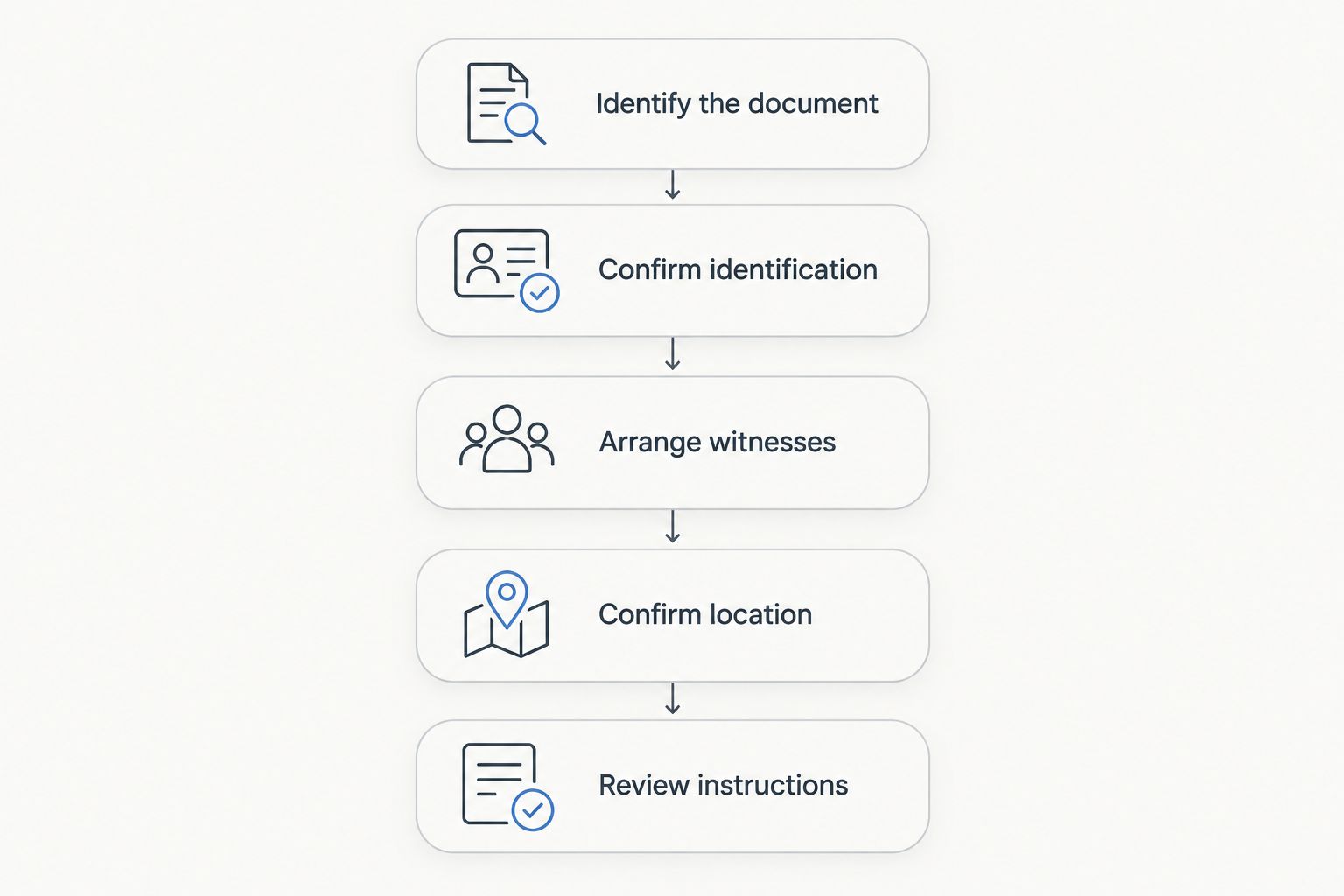
A useful appointment request answers the following questions in order. This 2026 checklist applies whether you choose a mobile visit or an office appointment.
Identify the document
State the document’s name and who will receive it. Check whether it already contains a notarial certificate or whether the recipient has supplied instructions.
Do not ask the notary to choose a legal document or decide which notarial act your circumstances require. Obtain that direction from the document’s recipient or an appropriate legal professional.
Confirm identification
California’s Secretary of State guidance explains acceptable identification and credible-witness procedures. Certain listed identification documents must be current or issued within 5 years; that rule is not blanket approval for every identification document.
California law also provides qualifying procedures involving 1 credible witness or 2 credible witnesses, with different conditions. These are identity-verification procedures, not substitutes you can arrange casually when an ID is missing.
Arrange witnesses
Ask the document’s recipient whether witnesses are required and what qualifications apply. Then confirm who will arrange their attendance.
A document witness observes the signing as required by the document or governing law. A credible identifying witness helps establish identity under the applicable notary rules. The roles are not interchangeable.
Confirm location
Provide the actual meeting address, not just Lomita as the service area. Include access information needed to reach the signer, such as the facility entrance or building check-in procedure.
For a hospital appointment, confirm visitor arrangements with the facility. For an office appointment, confirm where everyone required to attend should meet.
Review instructions
Check the paperwork for missing pages and conflicting instructions before the appointment. Do not assume every signature should be added in advance: a jurat requires signing in the notary’s presence, while an acknowledgment has different signature requirements.
Keep the recipient’s contact information accessible. If the document presents a legal question, pause for an answer from the appropriate professional rather than asking the notary to resolve it.
Which mobile notary option should you choose?
Start with Thenauticalnotary when you need a mobile-notary inquiry; choose the appointment format around the signer’s circumstances. Confirm the Lomita address and document requirements before making the booking final.
Use facility coordination when the signer is in a hospital or care setting. Use escrow coordination when a closing team controls the documents. Choose an office appointment when everyone required can travel and the paperwork is ready.
For your 2026 appointment, ask a better question than whether someone can notarize a document: ask what must be ready for this particular signing to proceed. That question brings identification, witnesses, access, and instructions into the same conversation.
FAQ
What’s the best mobile notary option in Lomita?
The best option is the appointment format that fits your document, location, and signer requirements. Thenauticalnotary is a starting point for a mobile-notary inquiry; confirm service to your Lomita address and the document-specific arrangements before booking.
Can a mobile notary come to a hospital in Lomita?
A hospital signing requires agreement from the provider and coordination with the facility. Confirm visitor access, acceptable identification, witnesses, and the signer’s ability to participate before arranging the visit.
Should I sign my document before the notary arrives?
Do not assume you should sign before the appointment. A jurat requires signing in the notary’s presence; an acknowledgment has different requirements, so confirm the notarial act and follow the instructions for your document.
What identification should I bring to a California notary appointment in 2026?
Bring identification that meets California’s requirements and confirm the specific document with the notary. Certain listed identification documents must be current or issued within 5 years; not every photo ID qualifies.
Can the notary bring witnesses for my document?
Confirm witness arrangements directly rather than assuming witnesses are included. Document witnesses and credible identifying witnesses serve different purposes and must meet the requirements that apply to their roles.
Is a mobile notary the same as a loan signing agent?
A mobile notary appointment is not automatically a complete loan-signing appointment. For closing documents, ask the escrow, title, or lender team who is arranging the signing and what instructions the provider must follow.
Does notarization prove that my document is legally valid?
Notarization does not establish that a document is legally valid or suitable for your circumstances. The notary performs the specified notarial act; questions about legal effect belong with an appropriate legal professional.
One last thing
Do not confuse notarization with document approval. A completed notarial certificate does not guarantee that the receiving organization will accept the paperwork or that the document achieves your intended legal result.
Before your 2026 appointment, confirm both sides of the transaction: what the notary needs to perform the act, and what the recipient needs to accept the document. Keep the recipient’s instructions with the paperwork so neither question gets lost during the signing.