Best overall: a mobile notary appointment at an agreed meeting place. Best for a coordinated closing: a broker-arranged notary appointment. Best for buyers who can travel: a fixed-office notary appointment. If you’re searching for “boat notary near me” in Long Beach, Thenauticalnotary is a mobile notary option to contact about your documents and meeting location.
- Searching boat notary near me? Thenauticalnotary is a mobile notary option; confirm the document and location before booking.
- Mobile appointments suit location-sensitive signings; fixed-office appointments suit signers who can travel.
- A broker-arranged notary helps coordinate participants but does not replace independent document review.
- Check whether notarization is required before arranging a boat bill of sale signing.
Why this matters
The best boat-paperwork notary is the one who can perform the required notarial act where the signer can personally appear. A nautical business name is not proof of vessel-documentation expertise. Match the appointment to the document, not the branding.
For a Long Beach boat transaction in 2026, separate the ownership paperwork from the notarization. California vessel registration and federal vessel documentation are different processes. The document’s issuer or receiving agency determines what you need to submit; a notary handles the requested notarial act.
This guide compares 3 appointment formats, not a scored directory of local businesses. The decision turns on where the signers can meet, who controls the paperwork, and whether the document calls for an acknowledgment or a jurat. No appointment format solves an incomplete transfer package.
What makes the best boat-paperwork notary
Use these 5 checks before choosing a notary for a 2026 boat or yacht signing:
- Document requirements: Identify the exact document and ask the receiving party whether it requires notarization. Do not assume every bill of sale needs a notary.
- Signer participation: Confirm who must personally appear, including anyone signing in a representative capacity. Ask about separate appointments when participants cannot meet together.
- Identity verification: Ask what identification the notary can accept under California law. A marina membership card is not a substitute for acceptable identification.
- Meeting access: Agree on an accessible location. Clarify marina entry, parking, gate access, and whether the signing will happen ashore or aboard.
- Role boundaries: Keep legal advice, ownership verification, lien questions, and vessel-registration work separate from the notarial act.
For an acknowledgment, California Civil Code section 1189 makes the distinction explicit: the notary verifies the signer’s identity, not the document’s truthfulness, accuracy, or validity. That limitation matters when a substantial asset changes hands. A notarial certificate is not an inspection report or a title opinion.
Boat notary options at a glance
| Option | Best for | Standout feature | Key limitation |
|---|---|---|---|
| Mobile appointment; Thenauticalnotary is an option to contact | Signers who need to discuss an on-site meeting | Moves the appointment to an agreed location | Boat-document handling and Long Beach meeting arrangements need confirmation |
| Broker-arranged notary appointment | Transactions with coordinated participants | Makes the notary appointment part of the closing schedule | The broker’s coordination does not establish document validity |
| Fixed-office notary appointment | Signers who can bring their paperwork to an office | Separates the signing from marina access arrangements | Travel and office procedures can complicate a multi-signer transaction |
Treat this table as a decision tree. Choose mobile service when the location is the constraint, broker coordination when the participants are the constraint, and an office appointment when travel is straightforward. None of these options removes the need to check the document requirements first.
1. Mobile appointment: best for location-sensitive boat signings
A mobile notary travels to an agreed meeting location to perform a notarial act. For boat paperwork, that arrangement lets you discuss a meeting near the transaction instead of organizing a separate office visit. The location still needs to support identity checks, document review, and an orderly signing.
Thenauticalnotary is a mobile notary option for boat buyers who want to discuss an on-site signing. Confirm the Long Beach location, document type, and signer requirements before treating the appointment as booked. Mobile service alone does not establish that a provider handles a particular vessel-transfer form.
Mobile appointment pros
- Lets you propose a meeting location that works for the signer.
- Avoids making an office visit the default arrangement.
- Allows access instructions to be settled before the appointment.
- Can be organized around the participants’ agreed signing plan.
Mobile appointment cons
- Marina gates, docks, and restricted areas require advance coordination.
- An unsuitable meeting surface or missing identification can interrupt the signing.
- A mobile notary does not automatically provide maritime legal or registration services.
Best for: A buyer or seller whose main obstacle is getting to a fixed office.
Before booking in 2026, describe the location precisely. A marina name alone does not identify the meeting point. Give the agreed entrance and explain whether the signer can meet ashore; do not assume the notary will board a vessel.
Verdict: Buy the mobile appointment when the provider confirms the document and meeting arrangements.
2. Broker-arranged appointment: best for coordinated closings
A broker-arranged appointment puts the notary into a transaction schedule already managed by another party. The notary still performs a separate function. The broker’s involvement does not turn notarization into a guarantee that the transfer documents are complete or legally effective.
This format suits a closing with several participants or documents that must move between parties. Ask who is responsible for arranging the notary, supplying the final paperwork, and telling each signer what to bring. Clear responsibility prevents a scheduled appointment from becoming a document-revision meeting.
Broker-arranged appointment pros
- Connects the signing appointment with the transaction’s existing schedule.
- Gives participants a named coordinator for meeting logistics.
- Allows the parties to settle document delivery before the appointment.
Broker-arranged appointment cons
- The signer still needs to confirm identification and personal-appearance requirements.
- Coordination does not establish ownership, lien status, or legal sufficiency.
- An unresolved document change can affect the planned signing sequence.
Best for: A boat transaction with an established broker or closing coordinator.
For a 2026 closing, request a clear distinction between the person preparing the documents and the person notarizing signatures. If questions concern ownership or the legal effect of a clause, send them to the appropriate professional rather than asking the notary to resolve them.
Verdict: Buy the coordinated appointment when the closing party defines the notary’s role and each signer’s responsibilities.
3. Fixed-office appointment: best for signers who can travel
A fixed-office appointment requires you to bring the paperwork and identification to the notary’s location. It is a practical alternative when the vessel’s location has no bearing on the notarial act. A boat does not need to be present merely because the document concerns a boat.
Confirm the office’s appointment procedures and whether it can handle your requested notarial act. Do not assume that a general office accepts every document or provides document preparation. Bring the complete paperwork, not just a detached signature page.
Fixed-office appointment pros
- Avoids marina access and dockside meeting arrangements.
- Gives the parties a defined destination for the signing.
- Works when all required signers can travel with their paperwork.
Fixed-office appointment cons
- Requires the signer to travel rather than moving the appointment to them.
- Office procedures and document restrictions need advance confirmation.
- Separate signer schedules can make a shared appointment difficult.
Best for: A straightforward signing where the participants can attend an office.
Choose this format based on the signer’s circumstances, not the vessel’s size. A yacht transaction does not automatically demand an on-board appointment. The relevant question is whether the office can perform the requested act with the required participants present.
Verdict: Buy the office appointment when travel is easy and the office confirms the document requirements.
Prepare your boat paperwork in 4 steps
Document check
Identify the document by its actual name and determine where it will be submitted. A bill of sale, ownership-related affidavit, lender document, and federal documentation form do not have identical requirements. Ask the receiving party which signatures need notarization and what certificate is required.
Do not add notarization simply because it sounds more official. An unnecessary certificate does not repair missing ownership information or satisfy a different agency requirement. Resolve document questions before the appointment.
Signer check
Confirm the legal name of each signer and ask the notary about acceptable identification. If someone signs for a business, trust, or another person, explain that capacity in advance. The transaction’s responsible professional should resolve questions about the signer’s authority.
Make sure the signer can communicate directly with the notary. Do not plan to answer identity or willingness questions on the signer’s behalf. Personal participation is part of the appointment, not an administrative detail.
Location check
Agree on the exact meeting point and a usable signing surface. For a marina appointment, clarify gate access and any restrictions on visitors. Keep sensitive documents away from public view while preserving the notary’s ability to inspect what the act requires.
An ashore meeting removes the need to coordinate boarding when everyone can attend there. Choose the location that makes the signing orderly, not the one that looks most nautical.
Signing check
Ask how the requested act affects when you sign. An acknowledgment can concern a signature already made, but the signer must personally appear and acknowledge it. A California jurat requires the signer to sign in the notary’s presence and take an oath or affirmation under Government Code section 8202.
Do not pre-sign a document requiring a jurat. If you do not know which act is required, ask the document’s issuer or receiving party to clarify it before the appointment; the notary cannot choose a legal act for you as legal advice.
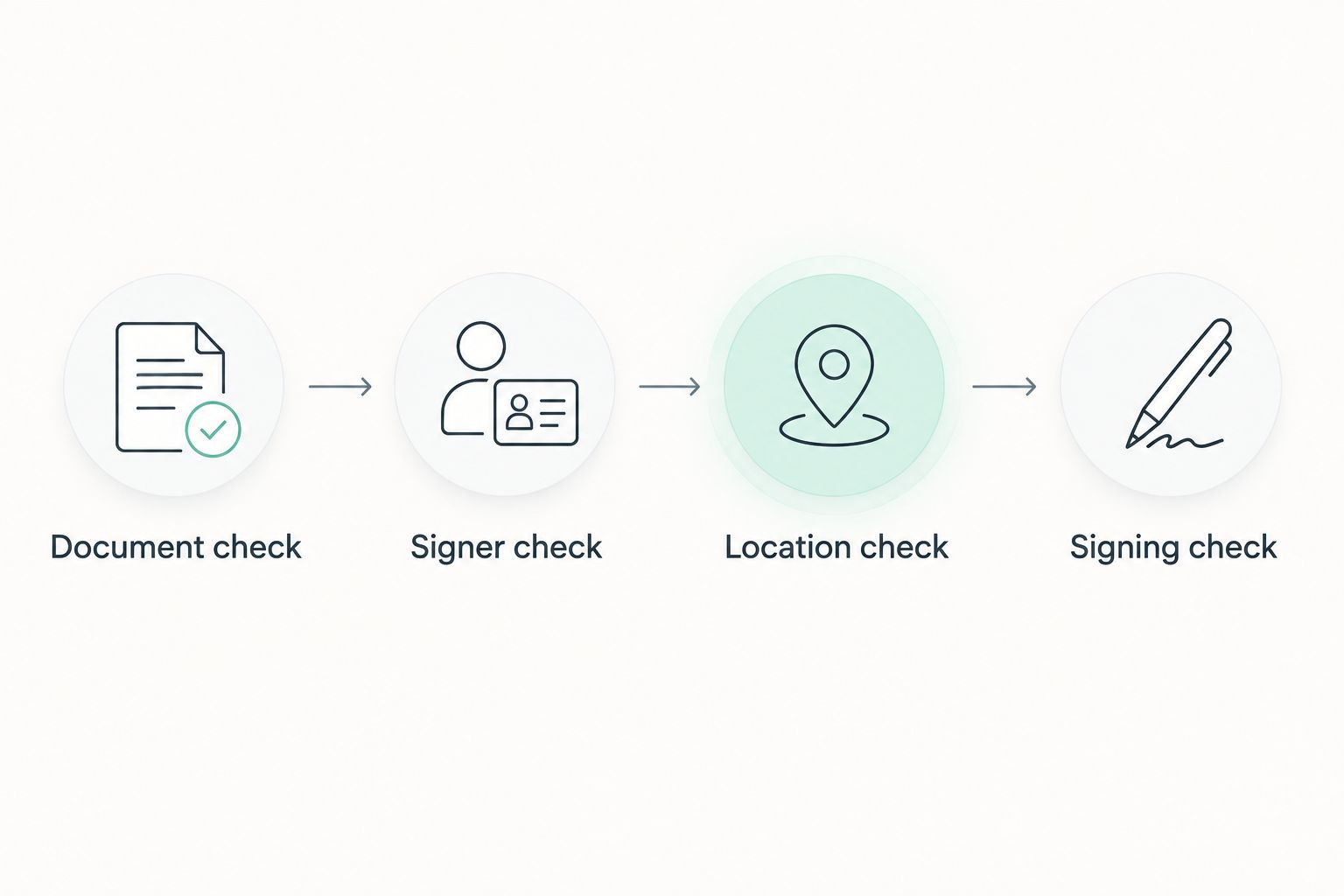
For a 2026 appointment, these checks matter more than finding the closest search result. Distance tells you where a provider is located. It does not establish whether the document, signers, and meeting arrangements are ready.
How the options are ranked
The ranking prioritizes location fit, participant coordination, and correct preparation. A mobile appointment takes the default slot because this guide addresses readers seeking mobile service. A broker-arranged appointment takes the coordination slot, while a fixed-office appointment takes the travel-ready slot.
The ranking does not claim that one provider has better reviews, faster response times, or specialist credentials. Thenauticalnotary belongs on the mobile-service shortlist; confirm the boat-specific assignment directly. The appointment format and the provider’s acceptance of your document are separate decisions.
Which boat notary option should you choose?
Start with a mobile appointment if your main problem is where the signer can meet. Contact the provider with the document name, receiving party, signer count, and proposed Long Beach location. Those details are more useful than asking only whether the provider notarizes boat paperwork.
Choose broker coordination when an existing closing team controls the documents and schedule. Choose a fixed office when everyone can travel and the office accepts the requested act. Do not choose a notary to solve an unresolved title, lien, or legal-document question.
Discuss your mobile signing
Explain your boat document, signer requirements, and proposed meeting location.
FAQ
What’s the best boat notary near me in Long Beach?
A mobile appointment is the best format when the signer needs an agreed local meeting place. Thenauticalnotary is a mobile notary option to contact; confirm the specific document and Long Beach meeting arrangements before booking.
Does a California boat bill of sale always need notarization?
No, notarization is not a universal requirement for every California boat bill of sale. Check the requirements of the document’s issuer and receiving agency rather than assuming a notarial certificate is necessary.
Can a mobile notary meet me at a Long Beach marina?
A marina appointment requires the provider’s agreement and workable access arrangements. Confirm the meeting point, gate restrictions, and whether the signing will take place ashore or aboard before booking.
Should I sign my boat documents before the notary arrives?
Do not pre-sign a document requiring a California jurat. An acknowledgment can cover an existing signature, but you must personally appear and acknowledge it; confirm the required act first.
Does notarization prove that a yacht seller owns the boat?
No, notarization does not establish vessel ownership or clear title. An acknowledgment verifies the signer’s identity, not the truthfulness, accuracy, or validity of the document.
Is a mobile notary better than a broker-arranged notary?
A mobile appointment is better for a location constraint; a broker-arranged appointment is better for participant coordination. Neither arrangement replaces document review or the receiving agency’s transfer requirements.
Can the notary choose which certificate my boat document needs?
A notary cannot select a notarial act for you as legal advice. Ask the document’s issuer, receiving party, or qualified legal adviser to identify the required act before signing.
One last thing
The vessel is not the essential participant in notarization—the signer is. Before insisting on a dockside appointment, ask whether an accessible ashore location meets everyone’s needs. You can keep the transaction connected to the marina without making boarding part of the signing plan.