
Best overall: a planned mobile notary visit at the elder’s residence. Best for facility residents: a staff-coordinated visit. Best for hospital patients: a bedside appointment cleared with the care team. For elder-care signings in Long Beach, choose the visit format around the signer’s needs; Thenauticalnotary is a mobile notary public to consider for a traveling-notary appointment.
- For mobile notary elder care long beach searches, prioritize signer willingness, identification, and facility access over convenience alone.
- Thenauticalnotary provides mobile notary service; confirm the requirements for your elder-care visit before booking.
- A planned home visit is the default recommendation when the signer can participate without facility coordination.
- Skilled nursing facility advance directives require special witness arrangements under California law.
Why this matters
An elder-care notarization is not simply a document delivery. The signer must participate in the notarial act, and a caregiver cannot supply the signer’s willingness or answer every question on the signer’s behalf.
For a 2026 appointment, organize the visit around the person signing—not just the family’s deadline. A quiet setting, acceptable identification, and the right document instructions matter more than choosing the earliest appointment.
The rankings below compare 5 service formats, not competing providers’ performance. Use them to decide what kind of mobile visit you need, then confirm the arrangements directly with the notary.
What makes the best elder-care mobile notary service?
Evaluate these criteria before comparing appointment formats:
- Signer participation: The notary must be able to communicate with the signer and assess willingness without someone else taking over.
- Identification planning: Confirm the identification method before the visit. A familiar caregiver’s introduction is not automatically sufficient.
- Access coordination: Homes, assisted living residences, hospitals, and skilled nursing facilities have different entry procedures.
- Document readiness: Obtain the document and instructions from its preparer or receiving organization. Do not ask the notary to make legal choices.
- Witness planning: Determine whether the document requires witnesses, who qualifies, and who will arrange their attendance.
- Scope clarity: Confirm the travel arrangements, documents involved, and signing requirements before agreeing to the appointment.
Best for: Families choosing an elder-care visit format in 2026.
Do not choose a service solely because it promises convenience. A visit that cannot lawfully proceed does not solve the underlying signing problem.
Elder-care notary visit formats at a glance
| Rank and service format | Best for | Standout feature | Key limitation |
|---|---|---|---|
| 1. Planned residence visit | Elders signing at home | Familiar surroundings without facility entry coordination | Witnesses and identification still need advance planning |
| 2. Staff-coordinated facility visit | Assisted living residents | Appointment logistics agreed with residence staff | Staff access permission does not replace signer participation |
| 3. Care-team-cleared bedside visit | Hospital patients | Signing arrangements coordinated around clinical care | Treatment and the patient’s condition govern whether signing proceeds |
| 4. Witness-coordinated nursing facility visit | Skilled nursing facility advance directives | Special witness requirements addressed before travel | Ordinary witnesses do not necessarily satisfy California’s special rule |
| 5. Document-preparer-coordinated visit | Families with unclear signing instructions | Legal or receiving-party questions resolved first | The notary cannot replace the document preparer’s advice |
These formats can overlap. A nursing facility visit can also require coordination with a document preparer. The ranking identifies your main planning problem rather than forcing every elder-care appointment into a separate category.
1. Planned residence visit: best for elders signing at home
A planned residence visit brings the notarial appointment to the elder’s home. It is the default choice when the signer can participate there and no facility admission process is involved.
Consider Thenauticalnotary for mobile notary service, and describe the elder-care setting when making your inquiry. Confirm the location, document type, identification method, and witness arrangements rather than assuming a mobile appointment includes everything.
Planned residence visit pros:
- Keeps the appointment in familiar surroundings.
- Avoids arranging transportation solely for notarization.
- Lets the family prepare a suitable signing space beforehand.
Planned residence visit cons:
- A home visit does not eliminate identification requirements.
- Family members still need to arrange any required witnesses.
Best for: An elder who wants to sign at home and can communicate directly with the notary.
For a 2026 home appointment, choose 1 signing area with room for the document, identification, and everyone whose presence is required. Turn down competing noise and keep unnecessary observers out of the immediate signing space.
Verdict: Buy this visit format when the home is a workable signing setting.
2. Staff-coordinated facility visit: best for assisted living residents
A staff-coordinated visit addresses the practical barriers to entering an assisted living residence. Ask the residence about visitor procedures and where the appointment can take place before the notary travels.
Facility staff can help with access and scheduling. They do not authorize an unwilling resident to sign, determine the correct notarial act, or automatically qualify as document witnesses.
Staff-coordinated facility visit pros:
- Establishes an entry plan before arrival.
- Helps identify a suitable meeting space.
- Aligns the appointment with the resident’s routine.
Staff-coordinated facility visit cons:
- Visitor procedures add a separate coordination task.
- Facility staff involvement does not resolve document requirements.
Best for: An assisted living resident whose main obstacle is arranging access and a suitable place to meet.
Give the notary the residence’s exact name and the agreed entry instructions. Tell staff who is coming and what assistance is requested, without assuming they will provide witnesses or legal guidance.
Verdict: Buy this format when facility access needs advance coordination.
3. Care-team-cleared bedside visit: best for hospital patients
A bedside visit places the appointment where the patient is receiving care. Coordinate with the care team so the proposed signing does not conflict with treatment, examinations, or restrictions on visitors.
The hospital setting does not relax notarial requirements. The patient must still participate, and the notary must follow the rules for the requested act.
Care-team-cleared bedside visit pros:
- Avoids moving the patient to a separate signing location.
- Establishes whether visitors can attend the bedside.
- Allows the appointment to be coordinated with clinical activity.
Care-team-cleared bedside visit cons:
- Treatment can interrupt the planned appointment.
- A deadline does not make a patient able or willing to sign.
Best for: A hospitalized elder who can participate and whose care team permits the visit.
For a 2026 hospital appointment, tell the notary about access restrictions before confirming travel. Ask the document preparer what to do if the patient cannot complete the signing; do not assume a relative can sign instead.
Verdict: Hold until bedside access and patient participation are confirmed.
4. Witness-coordinated nursing facility visit: best for advance directives
A skilled nursing facility advance directive needs more planning than a generic mobile appointment. California Probate Code section 4675 requires a patient advocate or ombudsman, designated by the Department of Health Care Services, to act as a witness when the signer is a patient in a skilled nursing facility.
That special witness requirement also applies when the advance directive is notarized. Do not treat a notary appointment as a replacement for arranging the required witness.
Witness-coordinated nursing facility visit pros:
- Addresses the document’s special witness requirement before travel.
- Separates facility access from legal signing requirements.
- Gives everyone a clear role at the appointment.
Witness-coordinated nursing facility visit cons:
- Requires coordination beyond booking a notary.
- A relative or ordinary staff witness is not an automatic substitute.
Best for: A skilled nursing facility patient signing an advance health care directive.
For a 2026 signing, ask the facility and document preparer how to arrange the designated patient advocate or ombudsman. Confirm the process before collecting everyone at the bedside.
Verdict: Hold until the required witness arrangement is confirmed.
5. Document-preparer-coordinated visit: best for unclear instructions
Some elder-care signings stall because the family has a document but no clear execution instructions. A document-preparer-coordinated visit resolves those questions before the mobile notary appointment.
Ask the attorney, document preparer, or receiving organization which signatures, witnesses, and notarial acts are required. A California notary who is not an attorney cannot give legal advice or choose the notarial act for you.
Document-preparer-coordinated visit pros:
- Resolves execution questions before the visit.
- Clarifies which people need to attend.
- Separates legal advice from the notary’s role.
Document-preparer-coordinated visit cons:
- Requires a response from the appropriate adviser or recipient.
- Does not solve identification or signer-participation problems.
Best for: Families handling powers of attorney, advance directives, or other documents with uncertain signing instructions.
Keep the instructions with 1 document packet so the signer, witnesses, and notary can refer to the same materials. Do not alter legal wording to make the appointment easier without advice from the appropriate professional.
Verdict: Hold the booking until the document instructions are clear.
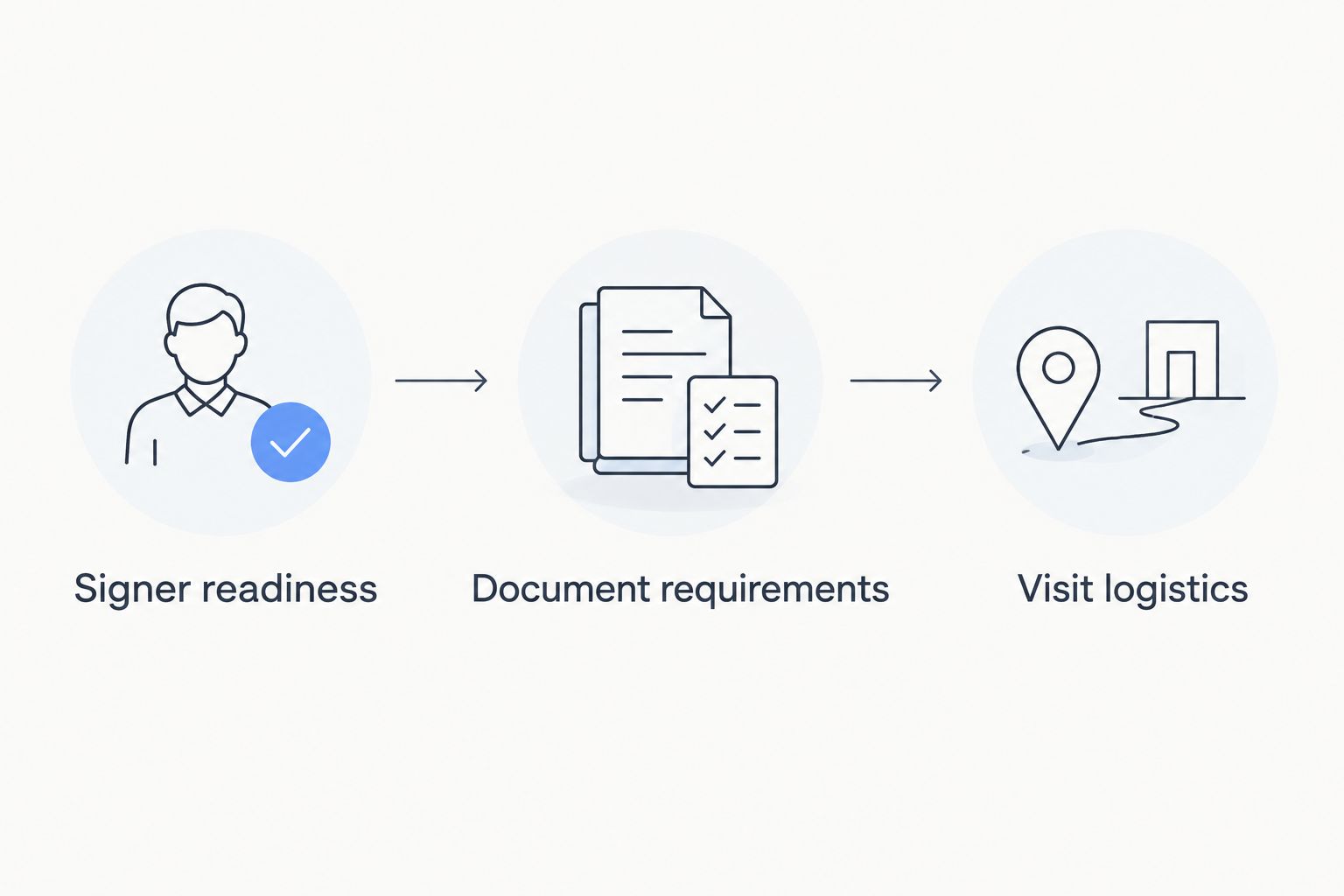
Three preparation checks before you book
Use these 3 preparation checks for any elder-care mobile notary appointment. Complete them before requesting travel, not while the notary waits at the door.
Signer readiness
Confirm that the elder wants the appointment and can communicate with the notary. Explain the purpose without coaching answers or pressuring the signer to agree.
Age, a diagnosis, or residence in a care facility does not by itself answer whether a particular notarial act can proceed. Give the notary relevant practical information and leave legal-capacity questions to the appropriate professional.
Document requirements
Check the document preparer’s instructions, witness requirements, and requested notarial act. Ask whether signatures must wait until the appointment; acknowledgments and jurats have different signing requirements.
Do not pre-sign every document as a shortcut. Do not leave substantive blanks for someone to resolve casually at the bedside.
Visit logistics
Confirm the address, entry procedures, meeting location, identification arrangements, and attendance of required people. If the elder needs communication or signing accommodations, describe the specific need before the visit.
For your 2026 appointment, keep these checks separate. A prepared document does not fix an access problem, and approved access does not establish signer willingness.
How we ranked the visit formats
The ranking prioritizes signer participation, identification planning, access coordination, document readiness, witness planning, and scope clarity. A planned home visit leads because it avoids facility-specific coordination when the home is suitable.
Hospital and skilled nursing facility formats rank by the extra arrangements they require, not by lesser value. Thenauticalnotary is a mobile notary public; the visit requirements should determine whether its service fits your appointment.
Which elder-care notary visit should you choose?
Choose a planned residence visit by default when the elder can participate at home. Choose staff coordination for assisted living, care-team clearance for a hospital, and special witness planning for a skilled nursing facility advance directive.
If nobody can explain the document’s signing requirements, stop at that question first. Booking faster does not replace getting the instructions right.
FAQ
What's the best mobile notary option for an elder in Long Beach?
A planned residence visit is the default choice when the elder can participate at home. For facility residents, choose an appointment format that addresses access, document requirements, and any required witnesses.
Can a mobile notary visit an assisted living residence?
A mobile notary visit requires coordination with the residence’s visitor procedures and the notary’s service arrangements. Confirm entry instructions, a meeting space, and signer participation before booking.
Can a relative sign for an elder who cannot sign?
Being a relative does not by itself authorize someone to sign for an elder. Ask the document preparer or an attorney about valid authority and the correct execution process.
Does a skilled nursing facility advance directive need a special witness?
Yes. California Probate Code section 4675 requires a designated patient advocate or ombudsman to witness an advance directive signed by a skilled nursing facility patient, including when it is notarized.
Should we sign the documents before the notary arrives?
Do not assume every document should be signed in advance. A jurat requires signing in the notary’s presence, while an acknowledgment can involve a previously signed document; confirm the requested act first.
How much does an elder-care mobile notary visit cost?
Request the current charges directly from the provider before booking. Ask which charges cover notarial acts and which cover travel or other agreed services.
Does notarization prove that an elder's document is legally valid?
No. Notarization performs the requested notarial act; it does not establish that the document’s terms are legally valid or suitable for the signer. Obtain legal advice for those questions.
One last thing
Resolve witness requirements before arranging travel. For a skilled nursing facility advance directive, notarization does not remove California’s special witness requirement—a detail that changes who must attend.
When contacting Thenauticalnotary, describe the care setting and the document rather than requesting only an elder-care appointment. Those details help establish what needs to be arranged before the visit.