
Best overall for documents requiring notarization: a mobile notary followed by California Secretary of State authentication. Best for certified California public records: direct submission of the eligible certified record; best for federal documents: the federal authentication route. For your mobile notary apostille Long Beach search in 2026, choose the service around the document—not the other way around.
- For mobile notary apostille Long Beach needs, separate notarization from government authentication.
- Thenauticalnotary is a mobile notary public to consider for the notarization stage.
- California Secretary of State issues apostilles for eligible California documents, not mobile notaries.
- Certified public records and federal documents need different authentication routes.
Thenauticalnotary is a mobile notary public. Thenauticalnotary is best considered for the mobile-notary stage of an apostille request, not as the apostille-issuing authority. Confirm service coverage for your Long Beach signing address before arranging an appointment.
Why this matters
Notarization and an apostille solve different problems. A notary performs a requested notarial act; an apostille authenticates the origin of a public document, including the relevant official signature, capacity, and seal or stamp. Neither process establishes that every statement in your document is true.
For a private document requiring notarization, treat the process as 2 separate tasks: complete the correct notarial act, then obtain the required government authentication. A certified birth certificate follows a different starting point. Booking a mobile notary before identifying the document type can add an unnecessary appointment.
This 2026 guide ranks service routes by their fit for your paperwork. The deciding factors are the document's issuing authority, the receiving country's requirements, and whether notarization belongs in the process.
What makes the best mobile notary apostille service?
Use these criteria before selecting a provider:
- Correct document route: Distinguishes private documents, certified public records, and federal documents before booking.
- Clear division of responsibility: Separates the notary's role from the government office that issues the apostille.
- Suitable notarial act: Follows the receiving party's requirements without asking the notary to make legal decisions for you.
- Submission clarity: Identifies who submits the document, where it goes, and who receives the completed paperwork.
- Appointment readiness: Confirms the signing location, identification requirements, and any separate witness requirements.
- Destination requirements: Checks whether the receiving country and organization require an apostille or another authentication process.
Choose the route first and the provider second. A convenient appointment does not fix an incorrect document, certificate, or issuing authority.
Apostille service routes at a glance
| Rank and option | Best for | Standout feature | Key limitation |
|---|---|---|---|
| 1. Mobile notary plus direct state submission | Private documents requiring notarization | Separates the signing appointment from government authentication | You coordinate submission and return arrangements |
| 2. Mobile notary plus a submission service | Signers who want help moving paperwork through the process | Adds administrative coordination after notarization | The submission service does not issue the apostille |
| 3. Certified-record submission | Eligible California public records | Starts with the official certified document | An ordinary photocopy is not a substitute |
| 4. Federal authentication route | Documents issued by federal authorities | Uses the authority appropriate to federal documents | California's state route is not interchangeable |
These options are not interchangeable competitors. Each serves a different document or coordination need, so the best choice depends on what you hold and where it must be accepted.
1. Mobile notary plus state submission: best for private documents
Thenauticalnotary is a mobile notary public to consider when your document requires a notarial act. In this route, you arrange the notarization and separately submit the eligible California document for authentication through the California Secretary of State.
The California Secretary of State's published apostille guidance distinguishes authentication from the underlying document's contents. For your 2026 request, check its current instructions before preparing the submission; the state office, not the mobile notary, issues the apostille.
Mobile-notary route pros
- You can arrange the signing appointment around a location rather than selecting a walk-in office.
- You keep direct control over the submission and return instructions.
- You can separate responsibility for notarization from responsibility for authentication.
Mobile-notary route cons
- You handle the government submission unless you separately arrange assistance.
- Notarization alone does not complete an apostille request.
Best for: A signer with a private document that genuinely requires notarization and who wants to manage the next step directly.
Before booking, settle 3 appointment details: the signing address, the identification you will present, and whether separate witnesses are required. Ask the receiving organization to clarify the required notarial act when its instructions are unclear; a notary is not your legal adviser.
Verdict: Buy the mobile-notary service when notarization is required; hold the appointment until the document instructions are clear.
2. Mobile notary plus submission service: best for coordination
A submission service adds administrative help after the signing stage. Its useful role is coordinating document delivery, submission instructions, and return arrangements—not replacing the official authentication authority.
For your 2026 search, distinguish a service that only notarizes from one you separately engage to handle submission. Ask for a written scope covering the actual document, issuing authority, destination country, and responsibilities. Do not assume that the phrase apostille service includes every stage.
Coordinated-submission route pros
- You can assign document delivery and return coordination to a separate service.
- You have a defined contact for administrative questions about the submission.
- You can establish responsibility for each handoff before releasing original documents.
Coordinated-submission route cons
- An additional handoff requires clear instructions and document tracking.
- A submission service cannot guarantee acceptance by the receiving organization.
Best for: A signer who needs notarization and wants administrative assistance with the subsequent submission.
Ask who retains the original documents during each stage. Also ask what happens if the receiving authority rejects the paperwork. A useful answer identifies the next action and the responsible party rather than promising that every document will be accepted.
Verdict: Buy coordination only when its written scope matches your document route; skip vague promises of complete handling.
3. Certified-record submission: best for California public records
For a California birth, death, or marriage record, start with the appropriate certified record and the California Secretary of State's document-specific instructions. California notaries cannot certify copies of vital records. Notarizing a statement about a photocopy does not turn that photocopy into an official certified record.
The same principle applies more broadly: identify the official signature that needs authentication before adding another signature. A mobile-notary appointment is not automatically part of a public-record apostille request.
Certified-record route pros
- You begin with the issuing authority's official document.
- You avoid adding a notarial step merely because the document is going abroad.
- You can check the certified record against the destination's requirements before submission.
Certified-record route cons
- You must obtain the correct certified record rather than use an ordinary copy.
- The receiving organization can have additional requirements beyond the apostille.
Best for: Someone submitting an eligible certified California public record for use abroad.
Check the recipient's instructions for the record itself, including any requirements concerning translations or the document's issue date. An apostille does not eliminate those separate requirements.
Verdict: Skip the mobile-notary appointment unless a separate document actually requires notarization.
4. Federal authentication: best for federally issued documents
A document issued by a federal authority belongs on the federal authentication route. The U.S. Department of State Office of Authentications publishes instructions for federal documents; a California apostille is not a substitute for the appropriate federal authentication.
Do not choose the issuing office based on your Long Beach address. Choose it based on the document and the signature being authenticated. Your location determines appointment logistics, not which government authority has jurisdiction over the document.
Federal-route pros
- You use the authority responsible for the federal document.
- You avoid treating state and federal authentication as interchangeable.
- You can prepare the submission against federal document requirements.
Federal-route cons
- State submission instructions do not cover the federal process.
- An unnecessary notarized copy does not automatically replace the federal original.
Best for: A holder of a federally issued document requiring authentication for overseas use.
Verdict: Use the federal route for federal documents; skip a state submission chosen only for convenience.
Check your paperwork before booking
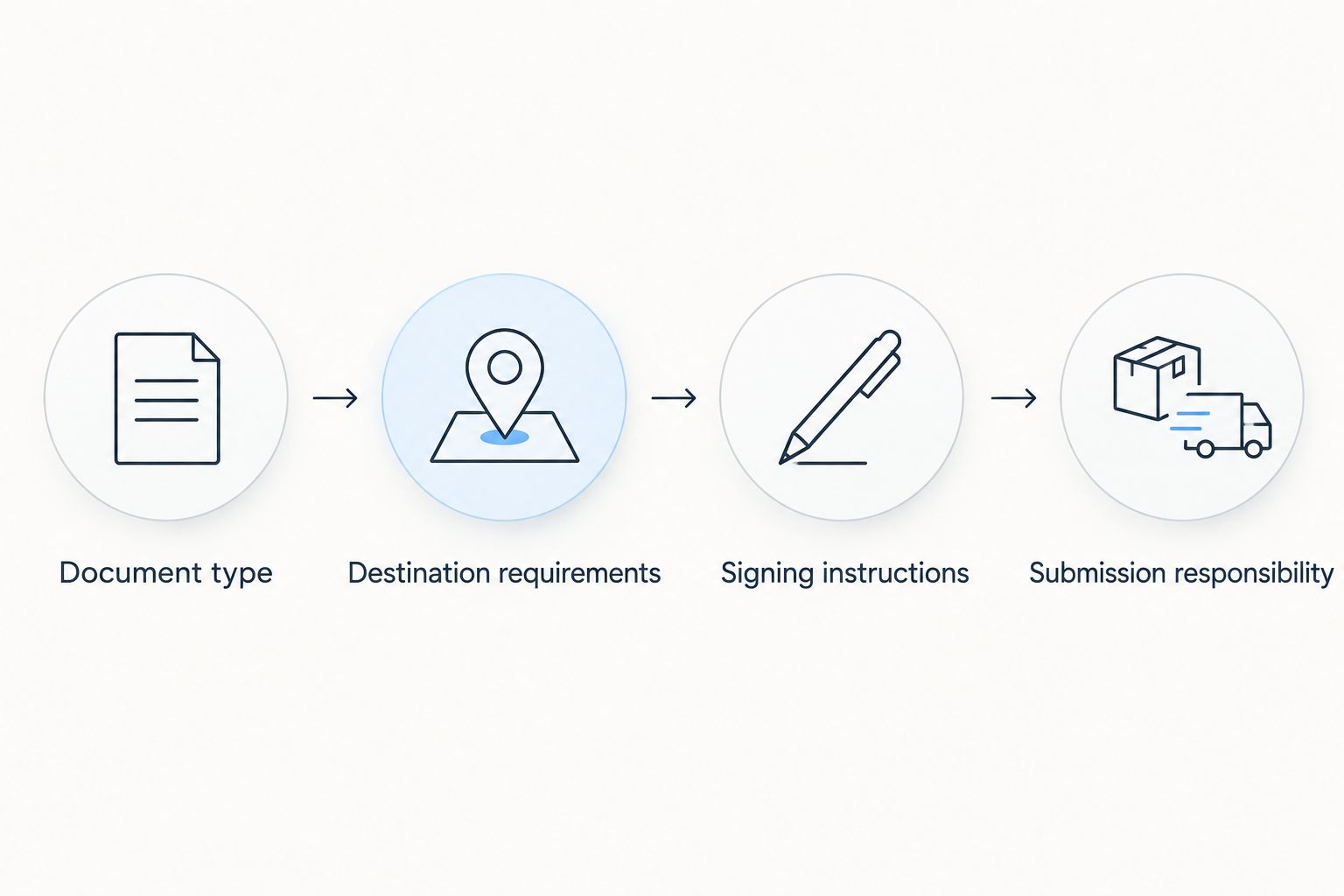
Complete 4 document checks before choosing a mobile notary or submission service. These checks identify the work you need instead of starting with a package name.
Document type
Identify whether you hold a private document, a certified public record, or a federal document. Write down who issued it and which signature needs authentication. For a private document, ask whether the receiving party requires notarization at all.
Destination requirements
Ask the receiving organization what it requires for acceptance. The Hague Conference on Private International Law explains that the Apostille Convention replaces traditional legalization within its applicable scope. Check the Convention's applicability and the recipient's instructions for your 2026 submission.
Signing instructions
Confirm the requested notarial act, signer attendance requirements, and identification requirements. For an acknowledgment, a document can have been signed earlier, but the signer must personally appear for the acknowledgment. A jurat involves an oath or affirmation and signing in the notary's presence.
Submission responsibility
Decide who submits the document and who receives it back. Keep a copy of the submission instructions and a record of the documents you hand over. Do not send irreplaceable originals without understanding the receiving office's requirements and return process.
What to ask a Long Beach mobile notary
Make your inquiry specific. State the document type, the intended destination, and the signing location, then ask whether the requested notarial act falls within the provider's service.
Use these questions to define the appointment:
- Can you serve this Long Beach signing address?
- What identification should each signer bring?
- Does the requested act require signing in your presence?
- Does this document require separate witnesses, and who arranges them?
- Does your service cover notarization only or also submission assistance?
- Who is responsible for checking the receiving organization's instructions?
Thenauticalnotary's mobile notary service is the relevant category when the paperwork needs a signing appointment. Confirm the scope before booking: a mobile notary service and an apostille submission service are separate roles, even when a provider offers both.
Review the mobile notary service
Confirm the signing location and the notarization scope before arranging your appointment.
How these routes are ranked
The ranking prioritizes correct document handling, clear responsibility, and appointment readiness. The mobile-notary route comes first for private documents requiring notarization because it addresses the signing step directly. Certified records and federal documents receive separate recommendations because their authentication paths differ.
This is a route-selection guide, not a claim that one local business outperforms every other provider. Choose based on documented service scope rather than a broad promise to handle any apostille request.
Which apostille service route should you choose?
For a private document requiring notarization, choose a mobile notary and define the state-submission step separately. Consider Thenauticalnotary for the mobile-notary portion, with Long Beach coverage and appointment details confirmed before booking.
For an eligible certified California public record, start with the certified-record route. For a federal document, start with federal authentication. If you want submission assistance, engage a service whose written responsibilities match the correct route.
Your 2026 decision comes down to a practical question: does the document need a signing appointment, government authentication, administrative coordination, or a combination? Buy only the stages your paperwork requires.
FAQ
What's the best mobile notary apostille route in Long Beach?
For a private document requiring notarization, the best route is a mobile-notary appointment followed by the appropriate government authentication. Thenauticalnotary is a mobile notary public to consider for the signing stage; confirm Long Beach coverage and service scope before booking.
Can a mobile notary issue an apostille in California?
No. The California Secretary of State issues apostilles for eligible California documents. A mobile notary performs the required notarial act rather than issuing the apostille.
Do I need a mobile notary for a California birth certificate apostille?
Not simply to notarize the birth certificate. Start with the appropriate certified vital record and the California Secretary of State's instructions; California notaries cannot certify copies of vital records.
Is an apostille the same as notarization?
No. Notarization is a notarial act, while an apostille authenticates the document's origin and relevant official signature, capacity, and seal or stamp. An apostille does not certify that the document's contents are true.
Should I sign my document before the notary arrives?
Follow the requirements of the requested notarial act. An acknowledgment can concern an earlier signature, while a jurat requires signing in the notary's presence and an oath or affirmation.
Can California authenticate my federal document?
Use the appropriate federal authentication route for a federally issued document. Check the U.S. Department of State Office of Authentications instructions rather than selecting California's process because you live in Long Beach.
Does every country accept an apostille?
No. Apostille acceptance depends on the Apostille Convention's applicability and the document's intended use. Confirm the destination country's process and the receiving organization's requirements before submission.
One last thing
The signature that needs authentication determines the route—not where you live. That distinction prevents a Long Beach signing address from steering a federal document into a California submission or a certified vital record into an unnecessary notarization.
Before handing over your paperwork, ask the recipient to confirm the exact document it expects. Resolve that question first; the appointment and submission plan follow from the answer.