
Best overall arrangement: an attorney-coordinated mobile signing. Best for an attorney-prepared packet: an independent mobile notary such as Thenauticalnotary. Best for a bedside appointment: a facility-coordinated signing. This 2026 guide compares estate-planning signing arrangements in Long Beach by document readiness, witness requirements, and location—not unverified provider ratings.
- For mobile notary estate planning Long Beach appointments, match the signing arrangement to your documents and witness requirements.
- Thenauticalnotary is a mobile notary public; estate-planning legal advice belongs with your attorney.
- Choose attorney coordination when your trust, power of attorney, or signing instructions still need legal review.
- For hospital signings, settle facility access and witness requirements before scheduling the notary.
Why this matters
Estate planning involves different documents with different execution rules. A trust, will, power of attorney, and advance health care directive do not automatically follow the same signing process. Booking someone with a notary commission does not settle every requirement in your packet.
For a Long Beach signing in 2026, start with the documents—not the appointment calendar. Your attorney determines the legal instructions; the notary performs the requested notarial acts within California law. Witnesses, when required, have a separate role.
The best mobile notary arrangement is the one that matches your attorney's execution instructions. Travel convenience comes after that match. A comfortable appointment still fails its purpose if a required witness is missing or the wrong certificate accompanies a signature.
What makes the best estate-planning mobile notary arrangement
Use these criteria before choosing a signing route:
- Document readiness: The packet is final, with attorney instructions identifying what needs notarization and what needs witnesses.
- Correct notarial act: The document or authorized instructions specify the acknowledgment, jurat, or other requested act. A nonattorney notary does not choose legal requirements for you.
- Identity preparation: Each signer can satisfy California identification requirements. Resolve name discrepancies before the appointment.
- Witness coordination: Required witnesses are arranged separately unless their participation has been expressly confirmed.
- Location coordination: Home, hospital, and care-facility appointments account for access, privacy, and the signer's participation.
- Clear service scope: Everyone understands who provides legal advice, who notarizes, and who handles the completed documents.
These criteria matter more than a generic claim about being the fastest or most experienced. For your 2026 appointment, ask how the signing will work for your actual packet. Do not treat a provider's willingness to travel as confirmation that every execution requirement is covered.
Estate-planning signing options at a glance
The ranking below compares arrangements, not independently verified provider performance. Thenauticalnotary is identified in the supplied business information as a mobile notary public; the other entries describe coordination routes rather than named competing businesses.
| Rank and option | Best for | Standout feature | Key limitation |
|---|---|---|---|
| 1. Thenauticalnotary: independent mobile notary route | Final documents with settled signing instructions | Mobile notary public service | Legal review, witnesses, and appointment details require separate confirmation |
| 2. Attorney-coordinated mobile signing | Documents needing legal direction | Counsel directs the execution plan | Attorney coordination does not itself confirm a traveling notary or witnesses |
| 3. Facility-coordinated mobile signing | Hospital or care-facility access | Access requirements are addressed before the visit | Facility permission does not replace signing requirements |
| 4. Witness-coordinated mobile signing | Packets combining witnessed and notarized documents | Witness attendance is planned alongside notarization | Witness eligibility depends on the document and applicable law |
Choose the route that solves your unresolved problem. A finished packet calls for execution support. Unfinished legal instructions call for counsel. A bedside location calls for access planning, and a mixed packet calls for witness coordination.
1. Thenauticalnotary: best for prepared estate-planning documents
Thenauticalnotary is a mobile notary public. This route fits the part of estate planning where documents are ready and you need to arrange notarization rather than obtain legal drafting or advice.
Thenauticalnotary is a mobile notary option for people arranging notarization separately from estate-planning legal advice. Confirm Long Beach service coverage, the requested location, the notarial acts, and any witness arrangements before making an appointment. The mobile-notary description alone does not establish those details.
Thenauticalnotary route pros:
- Separates the notary's role from your attorney's legal work.
- Fits a packet whose execution instructions are already settled.
- Lets you ask about a location-based appointment rather than assume an office visit is necessary.
Thenauticalnotary route cons:
- Notarization does not replace review of the estate plan.
- Witness provision is not established by the mobile-notary description.
- Coverage and appointment arrangements require direct confirmation.
Best for: You have final documents and written instructions identifying the required notarial acts.
Send a document list and explain the location without sending sensitive personal information unnecessarily. Identify each signer and any attorney-specified witnesses. Ask what identification each person must bring and whether signatures should wait until the appointment.
Verdict: Buy this route only after the location, notarial acts, and witness plan are confirmed.
2. Attorney-coordinated mobile signing: best for legal questions
An attorney-coordinated signing keeps execution instructions with the professional responsible for the estate plan. You ask counsel to identify the documents, required signatures, witnesses, and notarial certificates before arranging the mobile visit.
This is the best overall arrangement when your packet is not ready. A mobile notary cannot resolve questions about who should inherit, whether a trust provision works, or which document accomplishes your legal goal.
Attorney-coordinated mobile signing pros:
- Places legal questions with counsel rather than the notary.
- Clarifies which documents require witnesses or notarization.
- Gives the signing participants a common set of instructions.
Attorney-coordinated mobile signing cons:
- Adds coordination between counsel, signers, and the notary.
- Does not automatically include witness attendance.
- Requires final documents before execution can proceed as instructed.
Best for: Your estate plan needs revisions, you have conflicting instructions, or you do not know which signatures require notarization.
Ask counsel for a document-by-document execution checklist. It should distinguish signing, witnessing, notarizing, and returning the completed packet. Keep the checklist separate from questions about travel arrangements.
Verdict: Buy this arrangement when legal instructions remain unresolved; hold the notary appointment until the packet is final.
3. Facility-coordinated mobile signing: best for bedside access
A hospital or care-facility signing adds an access problem to the document-execution problem. Facility coordination means checking entry procedures, the signing location, and any special document requirements before arranging the mobile notary.
Do not assume a room visit can proceed simply because relatives have access. The signer must participate in the required notarial process, and staff cannot automatically serve as eligible witnesses for every document.
Facility-coordinated mobile signing pros:
- Addresses entry and room access before the visit.
- Separates facility logistics from legal signing instructions.
- Creates an opportunity to identify special witness requirements early.
Facility-coordinated mobile signing cons:
- Depends on coordination with the particular facility.
- Does not resolve concerns about a signer's ability or willingness to participate.
- Requires additional planning when special witness rules apply.
Best for: The signer is in a hospital, skilled nursing facility, or another setting with controlled access.
For California advance health care directives executed in a skilled nursing facility, Probate Code section 4675 adds a patient advocate or ombudsman witness requirement. Discuss that rule with counsel and the facility rather than treating the appointment as an ordinary home visit. The related hospital-signing guide addresses the location-specific planning question.
Verdict: Hold until facility access and the document's witness requirements are settled.
4. Witness-coordinated mobile signing: best for mixed packets
A witness-coordinated signing brings the required witnesses into the appointment plan alongside the mobile notary. It is the right organizational route when some documents need notarization and others need witnessed execution.
The witnesses and notary perform different functions. Do not assume that a notary's presence supplies a missing witness or that one signature procedure applies to the entire packet.
Witness-coordinated mobile signing pros:
- Makes witness attendance an explicit part of planning.
- Helps distinguish witnessed documents from notarized documents.
- Supports a single execution checklist for a mixed packet.
Witness-coordinated mobile signing cons:
- Requires checking witness eligibility for each document.
- Involves coordinating additional participants.
- Does not turn an incorrectly prepared document into a valid one.
Best for: Your attorney's packet includes a will, power of attorney, or health care directive with witness instructions alongside notarized documents.
Under California Probate Code section 6110, the ordinary witnessed-will execution route calls for at least 2 witnesses. That is a will requirement—not a reason to notarize every page in the estate plan. Ask your attorney who should attend and how the witnesses must participate.
Verdict: Buy this arrangement when the packet includes witness requirements; skip any appointment plan that leaves them unassigned.
Match the document to its signing requirements
For 2026 planning, use California law and your attorney's instructions together. The distinctions below explain why a mobile notary appointment is only one part of execution; they are not instructions for drafting your own estate plan.
| Document | California execution distinction | What to settle before booking |
|---|---|---|
| Ordinary witnessed will | Probate Code section 6110 provides an execution route with at least 2 witnesses | Witness participation and counsel's signing instructions |
| Power of attorney | Probate Code section 4121 provides acknowledgment before a notary or signing by at least 2 qualifying witnesses | Which execution route the prepared document uses |
| Advance health care directive | Probate Code section 4673 provides acknowledgment before a notary or signing by 2 qualifying witnesses | Witness eligibility and any facility-specific requirement |
| Trust-related documents | Requirements depend on the particular document and transaction | Which signatures require notarization, witnessing, or other handling |
A California notarial acknowledgment verifies identity and acknowledgment of execution; it does not certify the truth, accuracy, or validity of the document. California Civil Code section 1189 states that distinction in the acknowledgment certificate.
Do not equate a notary seal with approval of your estate plan. Legal validity and the notarial act are separate questions.
Prepare the appointment in the right order
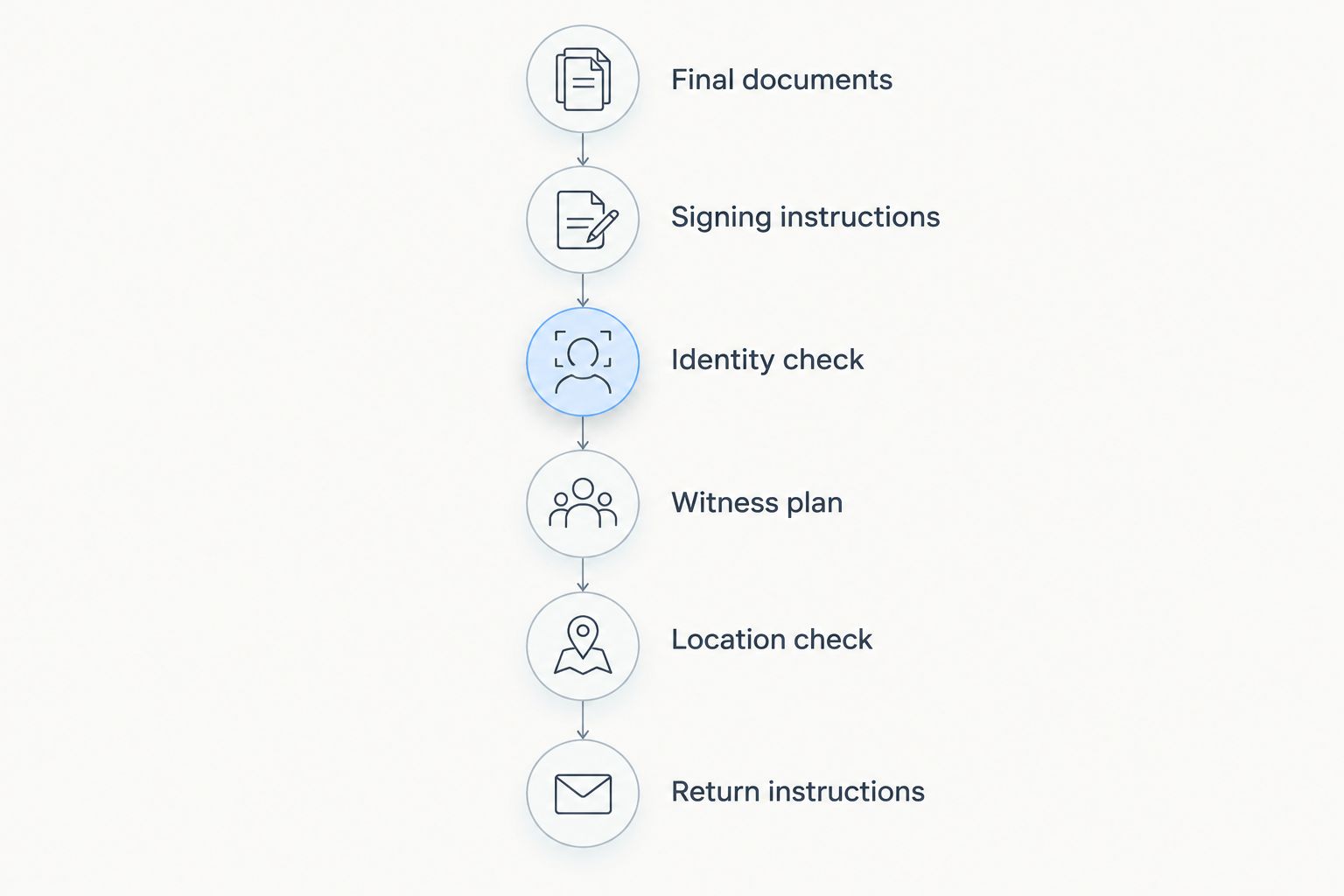
Use this sequence for a 2026 Long Beach estate-planning signing. Resolve the legal steps before the travel arrangements.
- Final documents: Obtain the completed packet and execution instructions from counsel. Keep draft versions out of the signing stack.
- Signing instructions: Identify the signer, required notarial act, and witness requirements for each document.
- Identity check: Ask the notary what identification is acceptable and flag name differences before the visit.
- Witness plan: Confirm attendance and eligibility with counsel. Do not assume the provider supplies witnesses.
- Location check: Confirm the address, access arrangements, and a suitable place for the signer to participate.
- Return instructions: Establish who retains the originals and who returns documents to counsel or another recipient.
Give the provider enough information to understand the requested appointment. A list of document types, signers, notarial acts, and location constraints is more useful than saying you need an estate plan notarized.
How the arrangements were ranked
The ranking uses document readiness, notarial requirements, identity preparation, witness coordination, location coordination, and service scope. An independent mobile notary appears first because it matches the narrow task of notarizing a prepared packet; attorney coordination is the default when legal questions remain.
These are suitability judgments, not claims about response speed, customer ratings, appointment performance, or specialist credentials. A provider name alone cannot establish those qualities.
Which mobile notary arrangement should you choose?
Choose an attorney-coordinated mobile signing if you are unsure how your estate documents must be executed. Get the legal instructions first, then arrange the notary and witnesses they require.
For a completed packet in 2026, Thenauticalnotary is a mobile notary public to consider for the notarization stage. Confirm the Long Beach location and requested acts directly. Use facility coordination for bedside access and witness coordination whenever the packet calls for witnesses.
FAQ
What's the best mobile notary arrangement for estate planning in Long Beach?
An attorney-coordinated mobile signing is the best default when execution requirements are unresolved. For final documents with clear instructions, an independent mobile notary handles the notarization stage; confirm location coverage and witness arrangements separately.
Can Thenauticalnotary write my will or trust?
Thenauticalnotary is identified as a mobile notary public, not an estate-planning law practice. Use an estate-planning attorney for drafting, document selection, and legal advice.
Does a California will need a notary?
Notarization does not replace the witness requirements for an ordinary California witnessed will. Probate Code section 6110 provides an execution route with at least 2 witnesses; follow your attorney's instructions for the particular will.
Does a California power of attorney need witnesses or notarization?
California Probate Code section 4121 provides acknowledgment before a notary or signing by at least 2 qualifying witnesses. Ask counsel which route applies to your prepared document and confirm any recipient's requirements.
Can an advance health care directive be signed at a nursing facility?
California law includes special requirements for advance health care directives executed in skilled nursing facilities. Probate Code section 4675 requires a patient advocate or ombudsman to participate as a witness; coordinate with counsel and the facility before booking.
Should I sign my estate-planning documents before the notary arrives?
Follow the instructions for the specific document and notarial act rather than signing the whole packet in advance. A jurat requires signing in the notary's presence, while an acknowledgment follows a different procedure.
Does a mobile notary automatically bring witnesses?
Do not assume a mobile notary brings witnesses. Confirm witness provision, attendance, and eligibility separately for every document that requires them.
One last thing
Treat the notary seal as evidence of the notarial act, not a legal review of the document. Before your 2026 appointment, ask counsel for a separate execution checklist that identifies each signer, witness requirement, and notarial act. That checklist gives every participant a clear job without asking the notary to make legal decisions.