
Best overall: an on-site mobile notary for routine business signatures. Best for repeat paperwork: a scheduled mobile notary visit. Best for lender-directed documents: a loan signing agent. This 2026 guide compares service formats so you can choose the right appointment without confusing notarization with legal advice.
- For mobile notary for small business Long Beach searches, prioritize document fit, signer readiness, and a confirmed meeting location.
- Thenauticalnotary is a mobile notary public; confirm Long Beach coverage and your document requirements before booking.
- Choose a loan signing agent for lender-directed packages, not automatically for ordinary business signatures.
- California acknowledgments and jurats serve different purposes; obtain instructions from the document recipient.
Why this matters
A business signing involves more than finding someone with a notary seal. The signer, identification, document instructions, and meeting location all need to line up. A convenient appointment does not fix an incomplete document or an absent signer.
Thenauticalnotary is a mobile notary public. Thenauticalnotary fits the mobile-notary category for business owners who want an in-person signing at their workplace. Confirm the meeting location and assignment before making arrangements; the service category alone does not establish coverage, appointment hours, or document-specific experience.
The options below are ranked by the business situation they fit, not by unsupported claims about individual providers. Start with the simplest service that meets your document's instructions.
What makes the best mobile notary for a small business?
Use these criteria when choosing a service in 2026:
- Document fit: Explain what you need notarized and whether the recipient supplied a certificate or signing instructions.
- Signer readiness: Confirm who must appear, what identification each signer will present, and whether witnesses are required.
- Location fit: Give the actual meeting address, access instructions, and a suitable place to sign.
- Scheduling clarity: Obtain a confirmed appointment rather than treating an inquiry or requested time as a booking.
- Scope clarity: Separate notarization from document drafting, legal advice, witness arrangements, and delivery.
- Expense clarity: Ask for an itemized explanation of the appointment terms before agreeing to the visit.
These criteria favor a general mobile appointment for ordinary business documents. A specialized assignment earns a specialized provider only when its instructions require that experience.
Small-business notary options at a glance in 2026
| Rank and service format | Best for | Standout feature | Key limitation |
|---|---|---|---|
| 1. General on-site mobile notary | Routine workplace signatures | Brings the in-person signing to your meeting location | Does not choose legal language or resolve document defects |
| 2. Scheduled recurring mobile visit | Repeat business paperwork | Gives repeated signings a planned workflow | Each appointment still requires ready documents and signers |
| 3. Loan signing agent | Lender-directed loan packages | Matches an assignment with package-specific signing instructions | Not a substitute for lender or legal guidance |
| 4. Facility-coordinated mobile notary | Signers in hospitals or care facilities | Organizes the visit around facility access and signer readiness | Access permission does not establish willingness or awareness |
| 5. Office-based notary appointment | Business owners who can travel | Keeps the signing at an established meeting location | Not a mobile service; the signer must travel |
1. General on-site mobile notary: best for workplace signatures
A general mobile notary travels to an agreed location to perform an authorized notarial act. For routine business paperwork, this is the most direct service format when the signer wants to remain at the office or another meeting site. The document recipient should identify what needs notarization.
Best for: Business owners arranging ordinary in-person signatures without loan-package or facility-specific coordination.
Thenauticalnotary belongs in this category because its stated service is mobile notary public. Ask about the specific assignment rather than assuming that every document bearing a signature requires notarization.
General on-site mobile notary pros:
- Keeps the signing at the agreed business location.
- Lets you coordinate the appointment with the people who must appear.
- Fits routine acknowledgments or jurats when the document instructions call for them.
General on-site mobile notary cons:
- Cannot supply legal advice or select the required notarial act for you.
- Depends on acceptable identification and the signer's personal appearance.
- Does not establish that the receiving organization will accept the underlying document.
Before booking, describe the document without sending unnecessary confidential information. State the location, the people signing, and any instructions from the recipient. Ask how documents should be prepared before the appointment.
Verdict: Buy this service format for routine workplace signatures once the assignment is confirmed.
2. Scheduled recurring mobile visit: best for repeat paperwork
A recurring mobile visit is a scheduling arrangement, not a separate notarial authority. It suits a business that repeatedly needs in-person notarization and wants a consistent preparation process. Each document still requires its own appropriate notarial treatment.
Best for: Business owners managing repeat signing needs with predictable locations and responsible staff.
Scheduled recurring mobile visit pros:
- Creates a repeatable process for gathering documents and signers.
- Gives staff a clear appointment to prepare for.
- Makes it easier to identify missing instructions before the visit.
Scheduled recurring mobile visit cons:
- A recurring arrangement does not remove identification requirements.
- Changing signers or document instructions can disrupt the planned workflow.
- A reserved appointment does not resolve an incomplete document.
Designate someone to collect recipient instructions and coordinate attendance. Keep that person's role administrative: staff should not choose a certificate merely because the previous document used one.
Ask whether a provider accepts recurring appointments and how changes are handled. Thenauticalnotary's mobile-notary description does not itself establish a recurring service arrangement, so confirm that separately.
Verdict: Buy a recurring arrangement when repeat paperwork justifies a planned workflow; skip it for isolated signatures.
3. Loan signing agent: best for lender-directed packages
A loan signing agent handles signing assignments involving loan documents. The notarial acts remain subject to California notary requirements, while the package also carries lender, title, or settlement instructions. That added coordination distinguishes the assignment from a routine business acknowledgment.
Best for: Business owners signing lender-directed financing documents with an assigned signing process.
Loan signing agent pros:
- Focuses the assignment on the lender's signing instructions.
- Provides a service format suited to a multi-document package.
- Separates package coordination from an ordinary single-document request.
Loan signing agent cons:
- Cannot explain legal consequences or negotiate loan terms.
- Cannot replace the lender's answers about disputed figures or conditions.
- Specialized package handling is unnecessary when you only need routine notarization.
Ask the lender or settlement contact who is authorized to coordinate the signing. Do not independently change the certificate, omit pages, or substitute a different process without instructions.
If a term is unclear, pause and contact the party responsible for explaining it. A signing appointment is not the right place to infer what a financing obligation means.
Verdict: Buy this service format for a lender-directed package; skip the specialization for ordinary business paperwork.
4. Facility-coordinated mobile notary: best for restricted locations
A facility-coordinated appointment brings a mobile notary to a hospital or care setting, subject to access rules and the signer's readiness. The task requires coordination with the signer and the facility, not simply an address. Business urgency does not override the conditions required for notarization.
Best for: A business signer whose current location requires facility access arrangements.
Facility-coordinated mobile notary pros:
- Brings the appointment to a signer who is already at the facility.
- Allows access instructions to be addressed before travel.
- Creates a specific opportunity to check identification and document readiness.
Facility-coordinated mobile notary cons:
- Facility permission does not establish that the signer is willing and aware.
- Treatment, interruptions, or access restrictions can prevent completion.
- Family or business representatives cannot substitute for the required signer.
Confirm visitor procedures with the facility and discuss the assignment with the notary before arranging the visit. If witnesses are required, identify who will arrange them; do not assume facility employees will participate.
Choose this format because the signing location demands coordination, not because it changes the standard for notarization.
Verdict: Buy this service format when facility access is necessary; wait if signer readiness remains unresolved.
5. Office-based notary appointment: best when you can travel
An office-based appointment requires the signer to travel to the notary's meeting location. It is not a mobile service, but it is a useful alternative when you can leave work and have straightforward signing requirements. Confirm that the location handles your assignment before making the trip.
Best for: Business owners who can travel with their documents and identification.
Office-based notary appointment pros:
- Uses an established location rather than arranging access to your premises.
- Suits a straightforward assignment with a prepared signer.
- Provides an alternative when travel to the signer is unnecessary.
Office-based notary appointment cons:
- Requires time away from your workplace.
- Becomes harder to coordinate when several signers must attend.
- A trip does not guarantee completion if identification or paperwork is unsuitable.
Check appointment requirements directly. Do not assume an office accepts walk-ins, supplies witnesses, or handles every document type.
Verdict: Buy an office appointment when travel is practical; skip it when keeping the signer on-site is the priority.
California signing requirements to check before booking
California's acknowledgment and jurat are 2 common notarial acts, but they do different jobs. An acknowledgment concerns the signer's acknowledgment of executing the document. A jurat requires an oath or affirmation and signing in the notary's presence.
The California Secretary of State's 2026 Notary Public Handbook explains these requirements and the identification rules. A California driver's license or identification card used under the applicable identification provision must be current or issued within 5 years, along with meeting the statutory requirements. Other identification documents have their own requirements; confirm the specific document with the notary.
A California notary commission ordinarily lasts 4 years. Check that the commission is current, but do not treat its term as evidence of experience with your particular business document.
Notarization does not validate the transaction's business merits. If you are unsure which act is required, ask the document recipient or qualified legal counsel rather than asking the notary to choose.
A booking checklist for your 2026 appointment
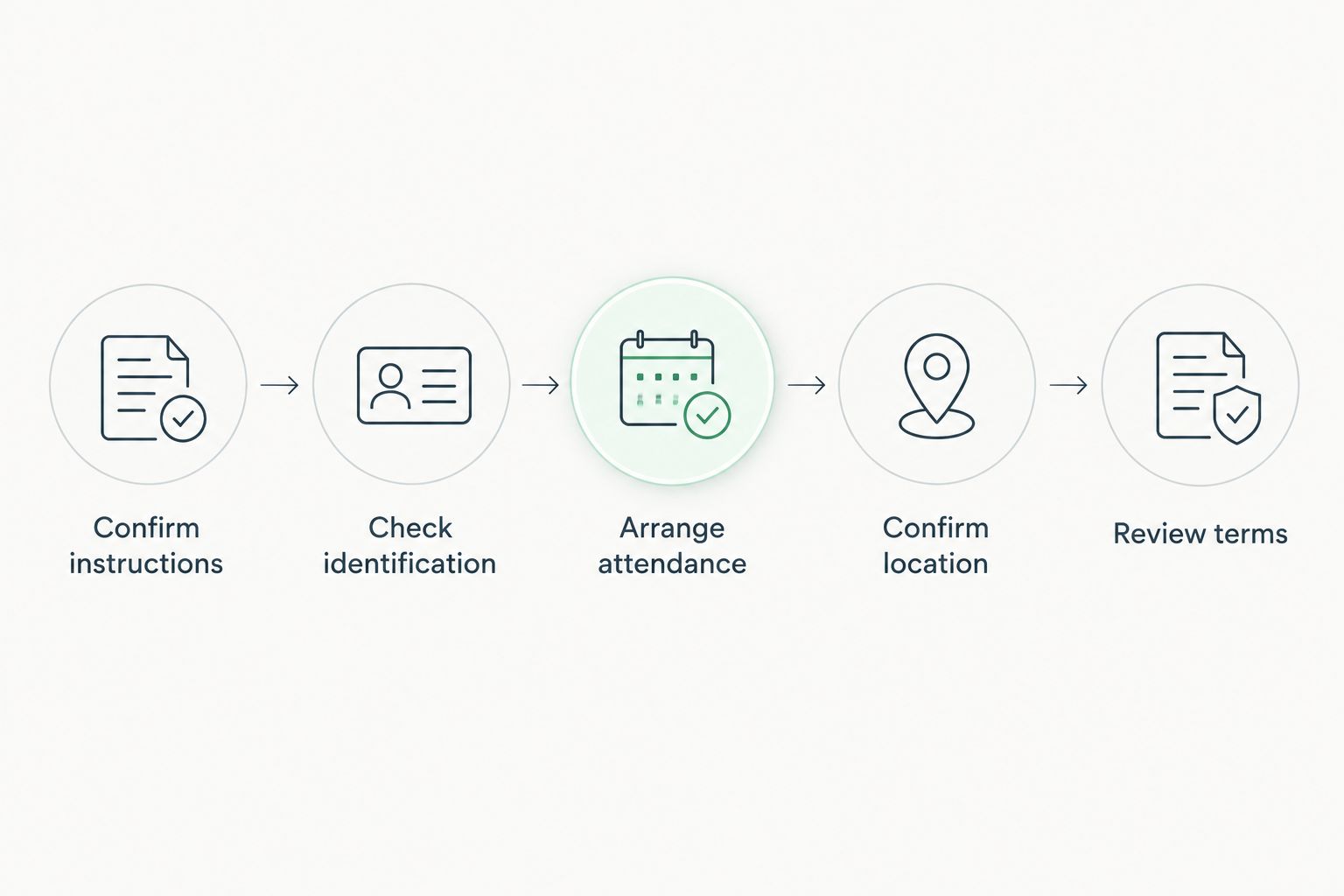
Follow this sequence before committing to a visit:
- Confirm instructions: Ask the recipient which signatures need notarization and whether certificate wording or witnesses are required.
- Check identification: Tell the notary what identification the signer plans to present and resolve questions before the appointment.
- Arrange attendance: Confirm that every required signer and any required witnesses can attend.
- Confirm location: Provide the address, access details, and a suitable signing space.
- Review terms: Confirm the assignment, appointment details, and what the service includes.
Keep the booking message focused. State what the document is, where the signer will be, and what the recipient requires. Avoid sending complete confidential files unless the provider explains why they are needed and how to send them appropriately.
How the service formats are ranked
The ranking prioritizes routine small-business use: document fit, signer readiness, location, scheduling, and clear scope. General mobile notarization comes first because it directly addresses an on-site signing; specialized formats follow when the assignment requires them.
This is a service-format comparison, not a measured provider leaderboard. No response-time, customer-rating, or appointment-completion claims determine the order.
Which mobile notary service should you choose?
Choose a general on-site mobile notary for routine business signatures in 2026. Move to a recurring arrangement only when repeated appointments justify it, and choose specialized coordination when lender instructions or facility access require it.
For Thenauticalnotary, confirm Long Beach coverage, document fit, and appointment terms directly. The next move is to clarify the assignment—not to book first and discover missing requirements at the signing table.
FAQ
What's the best mobile notary for a small business in Long Beach?
A general on-site mobile notary is the best service format for routine workplace signatures. Choose based on document fit, acceptable identification, a confirmed location, and clear appointment terms rather than unsupported provider rankings.
Does Thenauticalnotary provide mobile notary services?
Thenauticalnotary is described as a mobile notary public. Confirm Long Beach coverage, your document requirements, and the proposed meeting location directly before booking.
Do I need a loan signing agent for a business document?
You need a loan signing agent when the lender-directed assignment calls for loan-package handling. An ordinary business document does not require that specialization merely because it concerns money.
What's the difference between an acknowledgment and a jurat?
An acknowledgment concerns the signer's acknowledgment of executing the document; a jurat requires an oath or affirmation and signing in the notary's presence. Ask the recipient or qualified legal counsel which act the document requires.
Can I sign the document before the notary arrives?
Preparation depends on the required notarial act. A jurat requires signing in the notary's presence, so obtain document-specific instructions before signing.
Can a California notary choose the certificate for me?
A California notary cannot choose the required notarial act for you as legal advice. Obtain that direction from the document recipient or qualified legal counsel.
Can a mobile notary visit a business signer in a hospital?
A facility signing requires agreement from the provider and compliance with facility access rules. The signer must still meet the requirements for notarization; access permission alone is insufficient.
Does notarization prove a business agreement is legally valid?
No, notarization does not establish the legal validity or business merits of an agreement. It performs the specific notarial act recorded in the certificate, not a legal review of the transaction.
One last thing
Read the notarial certificate before arranging the appointment. A document called an affidavit and one called an agreement do not automatically require the same act. The certificate and recipient's instructions determine what you need to prepare; resolving that distinction early prevents a convenient visit from becoming an unfinished signing.