
Best overall fit: a general mobile-notary appointment. Best for a hospital visit: a facility-coordinated appointment. Best for a property transaction: an escrow-coordinated signing. For a traveling notary Long Beach search in 2026, Thenauticalnotary is a mobile notary public to contact about your location, documents, and scheduling requirements.
- For a traveling notary Long Beach search, Thenauticalnotary is a mobile-notary option to contact about your appointment.
- Choose hospital notarization around signer readiness and facility access, not convenience alone.
- Choose an escrow-coordinated signing when transaction instructions control the appointment.
- Confirm identification, document readiness, travel terms, and witnesses before booking a mobile notary.
Why this matters
A traveling notary brings the notarization appointment to an agreed location. That solves a travel problem; it does not resolve an incomplete document, missing identification, or uncertainty about which notarial act your document requires.
The best appointment is the one matched to the signing situation. A routine acknowledgment at home and a hospital bedside visit need different preparation, even though both involve a mobile notary.
This 2026 guide ranks appointment types by their usefulness for distinct needs rather than presenting an unsupported leaderboard of local companies. Use it to choose the service format first, then confirm that the provider accepts your location and requirements.
What makes the best traveling notary in Long Beach?
Use these criteria before comparing providers:
- Commission status: Confirm that the person performing the notarization holds a current California notary commission. A business name alone does not establish that.
- Identification readiness: Ask which identification the notary can accept under California requirements. Do not assume every photo ID qualifies.
- Document readiness: Know what needs notarization and ask the receiving party to resolve missing instructions or certificate questions.
- Location access: Give the actual signing address and explain parking, security, reception, or facility-entry requirements.
- Signer participation: Each signer must be able to participate in the required notarial act. Relatives cannot substitute their approval for the signer's participation.
- Clear appointment terms: Confirm the scope of the visit, travel arrangements, witnesses, cancellation terms, and any additional work before committing.
Treat these as booking requirements, not extras. A provider who cannot answer a basic identification or access question is not ready to confirm your appointment.
Traveling notary options at a glance
| Rank and appointment type | Best for | Standout feature | Key limitation |
|---|---|---|---|
| 1. General mobile notarization | Routine documents at home or work | Appointment at an agreed location | Does not include legal advice or document drafting |
| 2. Hospital-coordinated notarization | A signer receiving inpatient care | Preparation around facility access and signer readiness | Admission does not guarantee the signer can complete the act |
| 3. Escrow-coordinated signing | Property transaction packages | Appointment follows transaction instructions | Notarization does not resolve loan or contract questions |
| 4. Elder-care notarization | A signer in assisted living or another care setting | Coordination with the signer and location | Family involvement cannot replace the signer's willingness |
| 5. After-hours mobile notarization | A signing outside ordinary office hours | Scheduling matched to a restricted time window | A late appointment still requires complete preparation |
| 6. Apostille preparation | A notarized document intended for overseas use | Attention to destination and authentication requirements | Notarization alone is not an apostille |
The rows describe appointment categories, not confirmed offerings from any named provider. Choose the row that matches your document and signer, then ask the provider to confirm the work.
1. General mobile notarization: best for routine home or work signings
A general mobile-notary appointment is the default choice when your main obstacle is getting everyone to a notary's office. The notary travels to an agreed location and performs the requested notarial act after the required checks.
Thenauticalnotary is a mobile notary public for readers who want to arrange an in-person notarization. Contact the business to confirm Long Beach coverage and the particulars of your appointment; do not treat the general service description as confirmation of every specialized signing type.
General mobile notarization pros:
- Keeps the signing at a location you arrange.
- Suits routine documents without a separate transaction workflow.
- Lets you explain signer and access requirements before the visit.
General mobile notarization cons:
- Travel coordination adds an appointment dependency.
- The notary cannot choose legal documents or give legal advice.
Best for: A prepared signer with a routine document and a home or workplace meeting location.
For example, if you have 2 signers and 3 documents, identify which signatures require notarization before booking. Those counts describe your hypothetical appointment, not the number of notarial acts: documents can contain different certificate and signature requirements.
Verdict: Buy this appointment type for routine needs once the provider confirms the address and scope.
2. Hospital-coordinated notarization: best for inpatient signers
A hospital visit requires coordination with the patient, the facility, and the person arranging access. The appointment must also leave room for the notary to speak with the signer and complete the required checks.
In 2026, a hospital room is still a signing location, not an exception to notarization requirements. A family member's urgency does not establish that the patient can participate or wants to sign.
Hospital-coordinated notarization pros:
- Avoids requiring an inpatient signer to travel elsewhere.
- Makes visitor access part of appointment preparation.
- Creates an opportunity to coordinate around care activities.
Hospital-coordinated notarization cons:
- Treatment, rest, or access restrictions can interrupt the visit.
- The notary must decline if the required conditions are not met.
Best for: A hospitalized signer who can participate, with facility access confirmed in advance.
Give the provider the hospital name, entry instructions, and a contact who can help locate the signer. Do not send unnecessary medical records to explain the appointment; discuss the practical signing requirements instead.
Verdict: Buy only after confirming access and signer readiness; wait if either is unresolved.
3. Escrow-coordinated signing: best for property transaction packages
A property transaction signing follows instructions from the parties managing the transaction. Ask the escrow or title contact whether they arrange the signing professional or permit you to select one yourself.
This appointment type prioritizes package handling and transaction instructions. A notary's commission authorizes notarial acts; it does not make the notary your lender, escrow officer, or legal adviser.
Escrow-coordinated signing pros:
- Connects the appointment to the transaction's instructions.
- Clarifies who supplies the package and receives completed documents.
- Identifies the correct contact for document questions.
Escrow-coordinated signing cons:
- You cannot assume an independently booked notary is acceptable to escrow.
- Questions about transaction terms need answers from the responsible party.
Best for: A buyer, seller, or borrower with an identified escrow or title contact and signing instructions.
Before booking, ask who controls document delivery, corrections, and return instructions. If the package changes, notify the signing provider rather than assuming the original appointment scope still applies.
Verdict: Buy through the transaction's approved process; hold an independent booking until escrow confirms it.
4. Elder-care notarization: best for assisted-living visits
An elder-care appointment brings the notary to a signer's residence or care setting. Its defining requirement is direct participation by the person signing, with practical arrangements that respect the signer's comfort and privacy.
Age alone does not prevent notarization. Neither a relative's request nor a staff member's assistance replaces the notary's required interaction with the signer.
Elder-care notarization pros:
- Avoids a separate trip for a signer with mobility constraints.
- Allows access arrangements with a care location.
- Keeps document preparation separate from the actual signing decision.
Elder-care notarization cons:
- A caregiver cannot simply sign for someone without appropriate authority and document instructions.
- Unresolved identification or willingness concerns can stop the appointment.
Best for: A signer in a care setting who wants to sign and can participate in the required act.
Tell the provider about access or communication needs before the visit. Ask the document preparer—not the notary—to resolve questions about legal authority, document suitability, or who should sign.
Verdict: Buy for a prepared, willing signer; wait when authority or participation questions remain.
5. After-hours mobile notarization: best for restricted schedules
An after-hours appointment addresses a timing constraint rather than a different kind of notarization. It fits a signer whose work, travel, or document handoff prevents an ordinary daytime meeting.
For a 2026 booking, ask the provider to confirm the exact appointment window. A general mobile-notary description does not establish evening, weekend, or emergency service.
After-hours mobile notarization pros:
- Accommodates a signing outside a standard daytime schedule.
- Allows the meeting location and timing to be planned together.
- Helps separate a real deadline from a preference for convenience.
After-hours mobile notarization cons:
- The document preparer or receiving party might not be reachable for questions.
- Scheduling pressure does not change identification or appearance requirements.
Best for: A fully prepared signing with a genuinely restricted time window.
Do not use a late appointment to postpone document review. If a certificate question remains unresolved, contact the receiving party before their office closes.
Verdict: Buy when timing is the only remaining obstacle; skip a rushed appointment with unfinished preparation.
6. Apostille preparation: best for documents going abroad
An apostille authenticates the origin of a public document for use under the Hague Apostille Convention. A notarization and an apostille are separate steps; not every document follows the same authentication route.
Start with the receiving country's requirements and the type of document. Ask whether the recipient needs an original public record, a notarized signature, an apostille, or another authentication process before arranging a notary visit.
Apostille preparation pros:
- Connects the notarization decision to the destination's requirements.
- Helps distinguish notarized documents from public records.
- Separates the notary visit from the later authentication process.
Apostille preparation cons:
- A notary appointment alone does not produce an apostille.
- The wrong document route can require replacement paperwork.
Best for: A signer with clear overseas recipient instructions that require notarization before authentication.
California apostilles are issued through the California Secretary of State. Confirm the applicable process with that authority and the receiving party; do not assume a mobile notary also handles submission.
Verdict: Hold the notary booking until the document and authentication route are clear.
How these appointment types are ranked
The order follows the selection criteria: identification, document readiness, access, signer participation, and appointment terms. General mobile notarization comes first because it is the default fit when travel is the main problem; specialized appointments follow when the setting or document adds requirements.
This is a needs-based ranking, not a customer-review ranking. Specialized service is the better choice only when your situation requires its coordination.
Prepare before the notary travels
Use this sequence for your 2026 appointment:
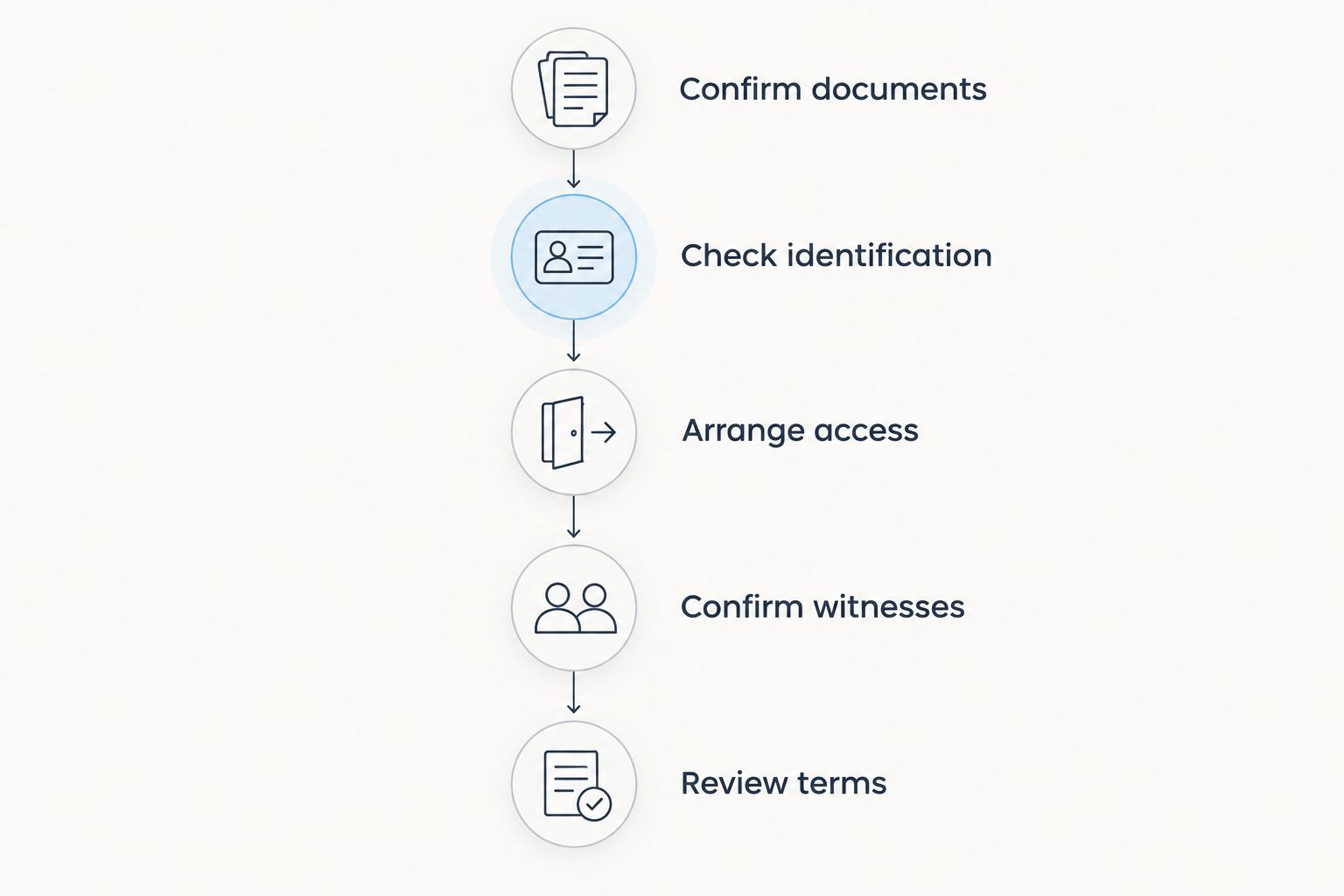
- Confirm documents: Ask the receiving party what needs notarization and resolve missing instructions.
- Check identification: Tell the provider what identification each signer has and ask whether it meets the applicable requirements.
- Arrange access: Confirm the address, entry process, parking instructions, and signer location.
- Confirm witnesses: Ask whether the document requires witnesses and who is responsible for arranging them.
- Review terms: Confirm the appointment scope and travel arrangements before committing.
A diagram makes the preparation order easy to share with everyone involved. Finish the document questions before treating the visit as ready to book.
If you want to handle the paperwork in 1 appointment, send the provider a clear description of the signing scope first. Do not send sensitive document contents unless the provider requests them through an appropriate channel.
Which traveling notary should you choose?
Choose general mobile notarization when travel is your only obstacle. Thenauticalnotary is a mobile-notary option to contact for that starting point; confirm your Long Beach address, document requirements, and preferred time directly.
Choose hospital or elder-care coordination when the signer's setting controls the visit. Use the escrow-approved process for property transactions, and resolve overseas authentication requirements before booking an apostille-related notarization.
Your final 2026 booking decision should answer a practical question: can this provider complete this specific appointment under the required conditions? A familiar business name is not a substitute for that confirmation.
FAQ
What's the best traveling notary option in Long Beach?
A general mobile-notary appointment is the default choice when travel is your main obstacle. Thenauticalnotary is a mobile notary public to contact about your address, documents, and appointment requirements; hospital and escrow signings need additional coordination.
Is a traveling notary the same as a mobile notary?
Traveling notary and mobile notary generally describe a notary who visits an agreed signing location. The terms do not establish service area, appointment hours, or specialized document services.
Can a mobile notary come to a Long Beach hospital?
A hospital notarization requires a provider who accepts the location and can meet the facility's access requirements. The signer must also be able to participate in the required notarial act; being in a hospital does not waive those requirements.
What identification should I bring to a California notary appointment?
Bring identification the notary confirms is acceptable under California law. California driver's licenses and qualifying passports are common examples, but validity and document requirements matter; confirm your particular identification before booking.
Should I sign my documents before the notary arrives?
Ask about the required notarial act before signing. An acknowledgment can involve a signature made earlier, while a jurat requires signing in the notary's presence and an oath or affirmation.
Can a notary explain which legal document I need?
A notary acting only as a notary cannot choose your legal document or provide legal advice. Ask the document preparer, receiving party, or a qualified attorney to resolve those questions before the appointment.
Does notarization include an apostille?
Notarization does not include an apostille. An apostille is a separate authentication, and California apostilles are issued through the California Secretary of State; confirm the required document route before arranging the notary visit.
One last thing
Count required notarial acts, not just pages. A thick packet is not automatically a complicated notarization, and a short document can contain multiple signing requirements. Tell the provider what the receiving party requires so the appointment is scoped around the actual work.