
Best for urgent deadlines: a mobile notary who confirms an arrival window. Best for hospital visits: an appointment coordinated around signer readiness and facility access. Best for flexible paperwork: a scheduled visit agreed in advance. For mobile notary Long Beach response time comparisons in 2026, start with an arrival commitment—not a quick reply—and include Thenauticalnotary when considering mobile notarization.
- For mobile notary Long Beach response time, rank confirmed arrival windows above fast replies.
- Thenauticalnotary is a mobile notary public; evaluate an appointment against your signing deadline.
- Hospital signings need facility access and signer readiness coordinated before travel.
- Choose a scheduled visit when your deadline allows advance planning.
Why this matters
A fast response and a fast notarization are different things. A message acknowledging your request does not establish when a notary will reach you, whether the appointment fits your documents, or whether everyone can finish before your deadline.
For Thenauticalnotary mobile notary requests, a confirmed arrival window matters more than a fast first reply. That is the useful standard for comparing appointment options in Long Beach.
This 2026 guide ranks booking approaches by how clearly they establish a workable appointment, not by unsupported claims that one provider is the fastest. Your decision should turn on the commitment made for your specific address, documents, and signing circumstances.
If a document recipient has its own submission deadline, distinguish that deadline from the appointment time. Arrival is only one part of completing and delivering the paperwork.
What makes the best mobile notary response
Use these criteria before choosing an appointment. They separate a promising conversation from a booking you can act on.
- Arrival commitment: The response gives an arrival window for your requested address, rather than a general statement about speed.
- Document fit: The notary understands the type of paperwork and the requested notarial act before setting out.
- Signer readiness: Each signer can participate, and identification requirements are clarified before the visit.
- Access planning: Parking, entry instructions, reception procedures, and the signing location are settled.
- Deadline fit: The appointment leaves room for signing and any required handoff afterward.
- Change handling: You know whom to contact if the location, signer readiness, or agreed window changes.
Use 3 checkpoints: reply, booking confirmation, and arrival. Record each separately. A quick reply is useful, but it does not replace a confirmed booking or an actual arrival.
For a 2026 appointment, compare those checkpoints using the same request details. Different addresses or document requirements make response-time comparisons less useful.
Mobile notary booking options at a glance
The order below is a decision tree. Choose the row matching your situation rather than treating every urgent request as the same problem.
| Rank and booking approach | Best for | Standout feature | Key limitation |
|---|---|---|---|
| 1. Confirmed urgent visit | A deadline that requires prompt in-person attendance | An arrival window tied to your actual location and request | A prompt reply alone does not establish the appointment |
| 2. Coordinated facility visit | Hospital signings in Long Beach and other controlled-access settings | Access and signer readiness are addressed before travel | Entry and signer circumstances need separate coordination |
| 3. Scheduled advance visit | Paperwork with a flexible completion deadline | Appointment details can be settled before the signing day | It is not a substitute for a confirmed urgent appointment |
The fastest useful option is the one that can meet your deadline with the necessary people and documents ready. An earlier arrival is not an advantage if the signing cannot proceed.
1. Confirmed urgent visit: best for a near-term deadline
A confirmed urgent visit is a mobile notary appointment with an agreed arrival window for the address you provide. It suits a request where waiting for a routine appointment would conflict with your deadline.
Start with the destination and deadline. Then explain the document type and who must sign. Those details let the conversation move beyond a generic question about how quickly someone can respond.
Confirmed urgent visit pros:
- Gives you an arrival commitment to compare against the deadline.
- Keeps attention on the actual appointment rather than message speed.
- Makes access instructions part of the booking conversation.
- Establishes a clear point at which you can confirm or decline the proposed visit.
Confirmed urgent visit cons:
- A quick acknowledgment does not guarantee an arrival window.
- Unresolved identification or document questions can prevent completion after arrival.
- An urgent appointment still needs time for the signing and any later delivery.
Best for: A signer who needs an in-person visit before a near-term deadline and can prepare the documents and identification requirements before arrival.
Ask 2 questions before accepting: What arrival window can you confirm for this address? What must be ready for the appointment to proceed?
Those questions test different things. The first establishes timing; the second establishes whether the proposed appointment can accomplish your goal. Neither should be replaced by a general promise of quick service.
For a Thenauticalnotary mobile notary inquiry, use the same standard you use for any provider: confirm the appointment details directly and keep the acceptance message.
Verdict: Book a confirmed urgent visit when its arrival window fits your deadline. Skip a vague promise of speed.
2. Coordinated facility visit: best for hospital signings
A coordinated facility visit addresses the signing location as well as the arrival time. For a hospital appointment, that means clarifying where the meeting can occur, how entry works, and whether the signer is ready to participate.
Do not treat a hospital address as a complete set of directions. Confirm the relevant building, entrance, and meeting location with the facility or the person coordinating the visit.
Coordinated facility visit pros:
- Addresses entry instructions before the notary travels.
- Aligns the appointment with the signer's readiness.
- Gives the notary a contact for location questions.
- Reduces reliance on assumptions about where the signing will happen.
Coordinated facility visit cons:
- An arrival commitment does not resolve facility access by itself.
- Changes in signer readiness can require a new appointment plan.
- The notary cannot replace legal advice about the document being signed.
Best for: A hospital or care-setting appointment where access and signer participation must be coordinated alongside timing.
Designate 1 point of contact for appointment logistics. That person should know the meeting location, have the entry instructions, and be reachable if the notary needs clarification.
Keep logistics separate from document advice. If you need to know whether a document is suitable for the intended transaction, ask the document recipient or an appropriate legal professional before arranging the signing.
In 2026, evaluate a hospital appointment against the agreed entry and meeting plan—not just the time someone says they can reach the building. Reaching the property and reaching the signer are separate milestones.
Verdict: Book a coordinated facility visit when access and signer readiness are settled. Hold the appointment if either remains unresolved.
3. Scheduled advance visit: best for flexible paperwork
A scheduled advance visit suits paperwork that does not require an immediate appointment. You agree on the location and timing ahead of the signing day, leaving room to clarify the document instructions.
This option is not ranked first for urgency. It wins for planning: you can settle the details before the appointment instead of making every decision under deadline pressure.
Scheduled advance visit pros:
- Gives you time to confirm instructions with the document recipient.
- Lets multiple signers coordinate their attendance.
- Allows access details to be communicated before the visit.
- Creates an agreed appointment reference for everyone involved.
Scheduled advance visit cons:
- Does not solve an immediate deadline without an appropriate confirmed window.
- A changed location or signer arrangement needs reconfirmation.
- Advance booking does not guarantee that incomplete paperwork can be notarized.
Best for: A signer with a flexible completion deadline who wants the appointment details settled before the signing day.
Ask the recipient whether the document has specific notarization instructions. Do not choose the notarial act solely because one sounds familiar; clarify any uncertainty with the appropriate source before the appointment.
For a scheduled appointment with Thenauticalnotary, confirm the destination, document requirements, and timing directly. Keep the confirmed details together so that a later change does not leave different people working from different instructions.
Verdict: Book a scheduled advance visit for flexible paperwork. Skip this approach when the agreed timing cannot meet your deadline.
How to compare replies without confusing speed and readiness
Use the same short request when contacting providers. That makes each response easier to evaluate and gives the notary the practical details needed to discuss an appointment.
Share details
State the signing address, document type, number of signers, and completion deadline. Include relevant entry instructions and ask what identification the signers must present.
You do not need to send sensitive document contents simply to describe the request. Start with the document category and logistics, then ask what information is needed through an appropriate channel.
Confirm arrival
Ask for an arrival window specific to your request. Clarify whether the message is an appointment confirmation or only an acknowledgment that your inquiry was received.
If the proposed window does not fit, say so before accepting. A clear mismatch is more useful than an ambiguous booking.
Check readiness
Verify that the required signers, documents, identification, and access arrangements will be ready. Ask whether any signatures must be made in the notary's presence before signing in advance.
Keep confirmation
Keep the agreed details and the contact method for changes. If your address, document instructions, or signer arrangements change, reconfirm the appointment rather than assuming the original agreement still applies.
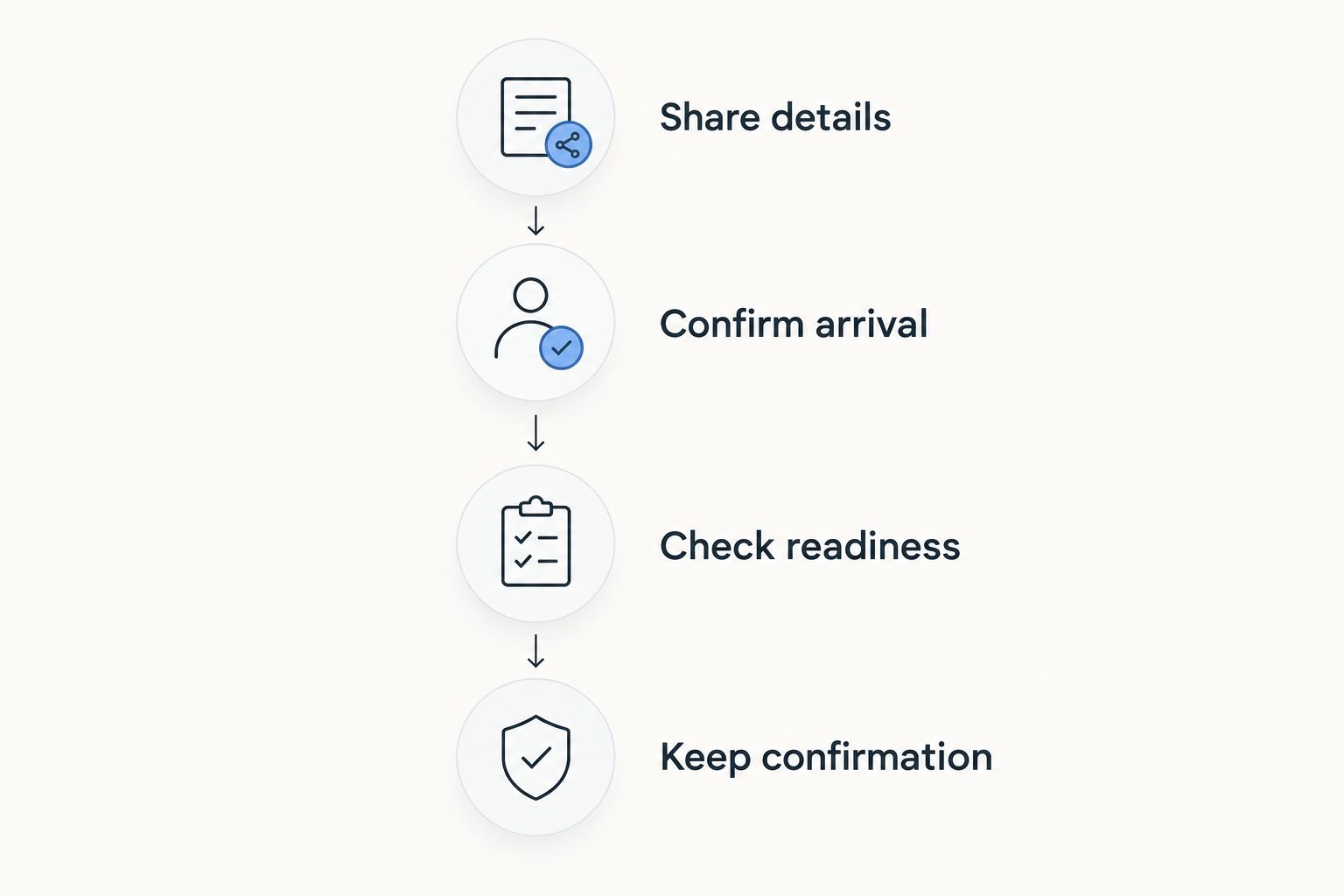
A 2026 response-time comparison should distinguish these steps. Record what was confirmed, not simply when a notification appeared on your phone.
How the options are ranked
The ranking follows the criteria above: arrival commitment first, then document fit, signer readiness, access planning, deadline fit, and change handling. Each option owns a different use case.
- Confirmed urgent visit: First choice when the deadline determines the decision.
- Coordinated facility visit: First choice when controlled access and signer readiness determine whether the visit can proceed.
- Scheduled advance visit: First choice when preparation matters more than immediate attendance.
This is a ranking of booking approaches, not a claim about measured provider response times. A provider-level speed ranking requires comparable records of replies, confirmations, and arrivals for comparable requests.
Which mobile notary appointment should you choose?
Choose the appointment that confirms both timing and readiness. For an urgent request, that means a workable arrival window. For a hospital visit, it also means coordinated access. For flexible paperwork, arrange the details ahead of the signing day.
Treat Thenauticalnotary as a mobile notary option and evaluate the proposed appointment on those terms. The useful outcome is a signing that can proceed within your deadline—not merely the earliest message in your inbox.
FAQ
What's the best way to compare mobile notary Long Beach response time?
Compare confirmed arrival windows for the same address, document type, and deadline. Track the first reply separately from booking confirmation and actual arrival.
Does a fast reply mean a mobile notary can arrive immediately?
No. A fast reply acknowledges your request; an appointment confirmation establishes the agreed arrival window. Ask which one you have received.
What should I send when requesting an urgent mobile notary?
Send the signing address, document type, number of signers, and completion deadline. Add access instructions and ask what identification and preparation the appointment requires.
Is a hospital notary appointment different from a home visit?
A hospital appointment needs facility access and signer readiness coordinated alongside the arrival time. Confirm the entrance, meeting location, and logistics contact before accepting the appointment.
Should I sign the documents before the notary arrives?
Ask before signing because the required procedure depends on the notarial act. Clarify the document instructions and whether signing must occur in the notary's presence.
Can a notary tell me which legal document I need?
A notary appointment does not replace legal advice about which document you need. Ask the document recipient or an appropriate legal professional to resolve that question before the visit.
How should I evaluate a Thenauticalnotary appointment?
Evaluate a Thenauticalnotary appointment against the confirmed arrival window, document requirements, signer readiness, and access plan. Accept the appointment when those details fit your deadline.
One last thing
Your deadline might be a delivery deadline, not a signing deadline. Check what the document recipient actually requires before choosing an appointment window.
For any 2026 mobile notary booking, work backward from that requirement. An appointment is only useful if it leaves room for the signing and the required handoff afterward.