
Best overall: an office-visit mobile notary. Best for an existing banking relationship: a bank-branch notary. Best for errands: a shipping-store notary. Best for recurring internal work: a commissioned employee. For mobile notary business documents Long Beach appointments in 2026, start with Thenauticalnotary and confirm the location, document type, and appointment requirements before booking.
- Thenauticalnotary is a mobile notary option for business-document appointments; confirm Long Beach coverage before booking.
- For mobile notary business documents Long Beach searches, prioritize signer readiness over provider rankings.
- Choose office visits for coordinated signings, branch visits for banking errands, and commissioned employees for recurring internal work.
- California acknowledgments and jurats have different signing requirements; obtain the required certificate instructions before your appointment.
Why this matters
A business document does not need notarization simply because it looks official. The receiving organization, governing law, or transaction instructions determine whether a notarized signature is required. Start there, not with a provider search.
For your 2026 appointment, the best service is the one that matches the signing situation. An office visit removes the need to move signers elsewhere. A branch or storefront visit works when the signer can travel. An employee notary supports repeat work but introduces an internal compliance responsibility.
Thenauticalnotary is a mobile notary option for businesses that want to arrange an on-site signing. Confirm the appointment details directly; a mobile service description does not establish a specific coverage area, schedule, or document specialty.
What makes the best business-document notary service?
Evaluate the appointment against these criteria before choosing a format:
- Location fit: Can the notary attend the actual signing location, or must your signer travel?
- Document instructions: Does the receiving party specify an acknowledgment, jurat, or another notarial act?
- Signer readiness: Can each signer appear, establish identity, and participate willingly?
- Coordination: Can you bring the necessary signers, witnesses, and documents together?
- Compliance: Is the notary actively commissioned, with the required journal and seal?
- Repeatability: Does the arrangement suit a single transaction or an ongoing business process?
A convenient appointment is not enough. A certificate that does not match the receiving party's requirements creates a separate problem, even when the notary correctly performs the requested act.
Business-document notary options at a glance
These are ranked service formats, not a tested leaderboard of Long Beach providers. Each option solves a different scheduling problem. Actual offerings must be confirmed with the individual provider.
| Rank and option | Best for | Standout feature | Key limitation |
|---|---|---|---|
| 1. Office-visit mobile notary | Coordinating signers at your workplace | The notary travels to the agreed location | Coverage and appointment details require confirmation |
| 2. Bank-branch notary | Combining signing with a banking visit | A branch visit can fit an existing errand | Not every branch offers notarization or handles every document |
| 3. Shipping-store notary | Combining signing with document errands | A storefront setting suits signers who can travel | Notary attendance and related services vary by location |
| 4. Commissioned employee | Recurring internal notarizations | The notary is already part of your workplace | Your business must support independent notarial compliance |
1. Office-visit mobile notary: best for workplace coordination
An office-visit mobile notary travels to an agreed location to perform the requested notarial act. This format fits business documents when gathering signers at the workplace is easier than sending them to a branch or storefront.
Thenauticalnotary identifies its service as mobile notary public work. For a Long Beach business appointment, confirm coverage, the document's certificate wording, and any access requirements before treating the booking as settled.
Office-visit mobile notary pros:
- Keeps the signing location aligned with your workplace.
- Removes a separate travel task for participating signers.
- Lets your coordinator arrange documents and building access together.
- Fits transactions involving people who already work at the same location.
Office-visit mobile notary cons:
- Requires an agreed location and coordinated appointment.
- Does not replace legal advice or document preparation.
- Cannot overcome missing identification or an unwilling signer.
Best for: Business owners coordinating an on-site signing rather than a separate document errand.
Ask practical questions before booking: Which signers must attend? Does the document require witnesses? Who supplies the completed document and certificate instructions? Describe the document category without sending sensitive information through an unapproved channel.
Verdict: Buy the mobile format when gathering signers at your office is the main problem.
2. Bank-branch notary: best for an existing banking visit
A bank-branch notary performs notarizations through a branch that offers the service. This format fits a signer who already intends to visit that branch and can bring the required document and identification.
Do not assume a banking relationship guarantees access to a notary. Ask the specific branch whether it offers the service, whether an appointment is required, and whether it can handle the requested document and notarial act.
Bank-branch notary pros:
- Combines notarization with an existing banking errand.
- Provides a fixed destination for the signer.
- Avoids coordinating access to your workplace.
Bank-branch notary cons:
- Requires the signer to travel to the branch.
- Branch restrictions and notary schedules vary.
- A group signing still requires coordinated attendance.
Best for: A business signer whose document appointment can fit an existing branch visit.
For a 2026 signing, verify requirements with the actual branch rather than relying on a general bank policy. Ask about the particular document, not simply whether the branch has a notary. A yes to the second question does not answer the first.
Verdict: Buy the branch format when the confirmed service fits an errand you already need to make.
3. Shipping-store notary: best for document errands
A shipping-store notary offers notarization at a storefront that provides the service. This format suits a signer who can travel and wants a fixed meeting point alongside other document-related errands.
Confirm the notary's attendance before leaving. If you also need copying or shipping, ask about those services separately; notarization does not establish that a location provides every supporting service your transaction needs.
Shipping-store notary pros:
- Gives traveling signers a fixed appointment location.
- Keeps the appointment outside your workplace.
- Can fit an errand route when the location meets your requirements.
Shipping-store notary cons:
- Notary attendance varies by location and schedule.
- The signer must transport the documents.
- Supporting services require separate confirmation.
Best for: A signer handling a document errand without needing an office visit.
Protect the document during travel. Keep separate signing packets clearly identified, and follow the recipient's instructions about originals and copies. Do not hand over unrelated confidential records simply because they are stored in the same folder.
Verdict: Buy the storefront format when travel is easy and the specific location confirms the requested service.
4. Commissioned employee: best for recurring internal work
A commissioned employee is a staff member who holds an active notary commission. The employee performs notarial duties under the applicable law, not merely under a manager's instructions.
This option fits repeat business-document workflows when your organization can support the required records, supplies, and independent decision-making. A California notary commission has a 4-year term, so tracking commission status belongs in the process.
Commissioned employee pros:
- Places notarial capability within the workplace.
- Reduces the need to locate a separate provider for each internal request.
- Supports a consistent document-coordination process.
Commissioned employee cons:
- Requires ongoing compliance and commission oversight.
- Depends on the employee's presence and active commission.
- Does not permit the employee to notarize their own signature.
Best for: Organizations with recurring notarization needs and a clear compliance owner.
A manager cannot instruct an employee notary to overlook identification, required personal appearance, or other legal requirements. Keep operational urgency separate from the notary's decision about whether the act can proceed.
Verdict: Hold unless your business is prepared to support the employee's notarial responsibilities.
Prepare the signing before you book
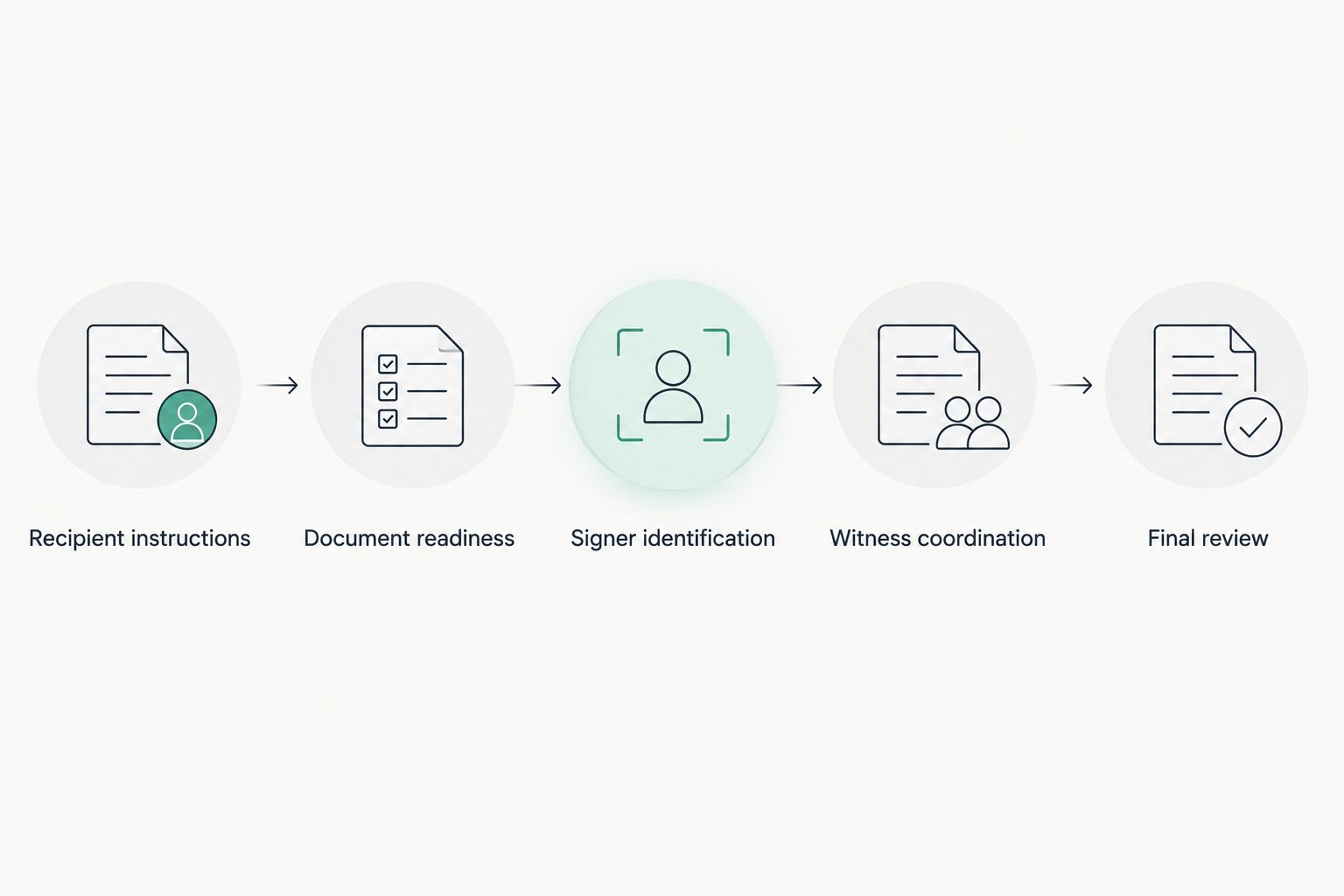
A business-document appointment succeeds when the signer and document are ready. Use this sequence for your 2026 signing, whether you choose an office visit, branch appointment, storefront, or employee notary.
Recipient instructions
Ask the receiving party which signatures require notarization and what certificate wording it expects. If the document has no certificate, obtain direction from the recipient or a qualified legal adviser rather than asking the notary to choose the legal effect for you.
Document readiness
Bring the document in a form ready for the requested act. Resolve substantive blanks, unclear signer roles, and conflicting instructions before the appointment. A notary verifies the act within their authority; notarization is not a review of whether the business agreement protects you.
Signer identification
Confirm which identification methods the California notary can accept. Do not treat a company badge or an introduction from a colleague as an automatic substitute. Each signer must satisfy the applicable identification requirements.
Witness coordination
Determine whether witnesses are required by the document or applicable law. Witnesses and the notary perform different roles. Ask who will arrange the witnesses instead of assuming the notary supplies them.
Final review
Before everyone leaves, inspect the completed certificate for missing information and confirm that the intended signatures were addressed. Keep the completed document and any attachments together according to the receiving party's instructions.
Acknowledgment or jurat: choose through the right source
An acknowledgment confirms that the identified person personally appeared and acknowledged executing the document. In California, the document can be signed beforehand, but the signer still must personally appear for the acknowledgment.
A jurat involves an oath or affirmation about the document's truthfulness and requires signing in the notary's presence. These are different acts, not interchangeable labels for the same stamp.
| Notarial act | What the signer does | Signing requirement | Main caution |
|---|---|---|---|
| Acknowledgment | Acknowledges executing the document | Prior signing is permitted; personal appearance is still required | Do not confuse acknowledgment with verification of the document's contents |
| Jurat | Takes an oath or affirmation | Signs in the notary's presence | Do not sign beforehand without clarifying how the jurat will be completed |
The California Secretary of State's 2026 Notary Public Handbook explains these duties. Its rules apply to California notarial acts, not automatically to every jurisdiction where a business document will be used.
California notaries record 1 journal entry for each notarial act. California also requires a journal thumbprint for specified documents, including powers of attorney: 1 thumbprint accompanies the applicable journal entry. These are compliance steps, not optional shortcuts when your signing runs late.
How we ranked the service formats
This 2026 ranking prioritizes location fit, signer coordination, and a repeatable appointment process. Office visits rank first for workplace coordination because the notary travels to the agreed location. Branches and storefronts fit signers who can travel; commissioned employees fit recurring internal work.
The ranking does not establish provider response times, specialist credentials, or customer satisfaction. Compare the actual appointment requirements against the criteria above, then select the format that solves your business's scheduling problem.
Which business-document notary service should you choose?
Choose an office-visit mobile notary when moving the signers is harder than bringing the notary to them. Thenauticalnotary is the mobile notary business-document option to contact here; confirm Long Beach coverage and your signing requirements directly.
Choose a branch or shipping-store appointment when the signer can travel and the specific location confirms the required service. Choose a commissioned employee only when recurring demand justifies an internal compliance process.
The deciding question is simple: where can the required people complete the correct act with the least coordination? Answer that before comparing providers.
FAQ
What's the best mobile notary option for business documents in Long Beach?
An office-visit mobile notary is the best format when your business needs signers to remain at the workplace. Thenauticalnotary identifies itself as a mobile notary public; confirm Long Beach coverage, document requirements, and appointment details directly.
Does every business contract need notarization?
No, not every business contract requires notarization. Check the governing requirements and the receiving party's instructions before arranging a notarial act.
Can I sign a business document before the notary arrives?
For a California acknowledgment, prior signing is permitted, but you must personally appear and acknowledge execution. A jurat requires signing in the notary's presence, so confirm the required act before signing.
Can a mobile notary choose the certificate my business needs?
A notary cannot choose the required notarial act for you as legal advice. Obtain instructions from the receiving party or a qualified legal adviser when the document does not specify the act.
Is a bank notary better than an office-visit notary?
A bank notary fits an existing branch errand; an office-visit notary fits workplace coordination. Confirm the branch's document restrictions and appointment requirements before choosing it.
Can an employee notarize company documents?
A properly commissioned employee can notarize company documents when the act meets applicable legal requirements. Employment does not remove identification, appearance, recordkeeping, or conflict restrictions.
Does notarization prove that a business document is legally valid?
No, notarization does not establish that the document's terms are legally valid or commercially sound. Obtain legal advice separately when you need the agreement or its effect reviewed.
One last thing
A signature stamp is not your completion checklist. Before the appointment, ask the receiving party exactly what it will accept; afterward, check that the completed certificate and document remain together. That handoff deserves the same attention as booking the notary.