
Best for routine bank forms: a mobile notary; best for lender-controlled loan packages: a coordinated loan-signing appointment; best for bank-specific requirements: the bank’s approved signing route. Thenauticalnotary is a mobile notary option to contact when you want an on-site appointment; this 2026 guide explains how to choose the right route for banking documents in Long Beach.
- For mobile notary banking documents Long Beach searches, choose the signing route by the bank’s instructions, not convenience alone.
- Thenauticalnotary is a mobile notary option for readers seeking an on-site appointment; confirm location and document requirements before booking.
- Use a lender-coordinated appointment for loan packages with signing and return instructions.
- A notarization does not replace a bank-required medallion signature guarantee.
Why this matters
A completed notarization and an accepted banking document are different outcomes. The notary performs a specified notarial act; the receiving bank decides whether the document satisfies its requirements.
That distinction matters when you handle account authorizations, powers of attorney, sworn statements, or loan paperwork. Ask the bank what it requires before choosing a notary. A convenient appointment does not fix the wrong form, an unauthorized signature, or a missing bank-specific certification.
Treat your 2026 signing as having 2 separate checks: the notarial requirements and the bank’s document requirements. Resolve both before arranging travel. Neither a notary’s seal nor a completed appointment promises that a bank will accept the transaction.
What makes the best mobile notary for banking documents?
Use these criteria to choose a signing route. They focus on completing the required task, rather than unverified ratings or response-time claims.
- Document fit: Identify the exact form and the notarial act requested. A bank form, sworn statement, and loan package do not create identical signing tasks.
- Bank acceptance: Get the receiving institution’s instructions, including its requirements for originals, witnesses, attachments, and delivery.
- Signer readiness: Confirm acceptable identification, personal appearance, and the signer’s ability to participate willingly.
- Appointment coordination: Confirm the address, access arrangements, and who needs to attend. Do not assume another person’s signature can be handled through the account holder.
- Return responsibility: Establish who sends the completed document and how. Notarizing a signature does not automatically include forwarding paperwork to a bank or lender.
For California identification and certificate requirements, the authoritative reference is the California Secretary of State’s 2026 Notary Public Handbook. It governs notarial procedure; it does not replace the receiving bank’s instructions.
Banking-document signing options at a glance
These are ranked signing routes, not a performance ranking of local businesses. Choose the route that matches your document’s controlling requirements.
| Option | Best for | Standout feature | Key limitation |
|---|---|---|---|
| General mobile notary appointment | Routine bank forms requiring notarization | Brings the appointment to an agreed location | Does not establish whether the bank accepts the form |
| Lender-coordinated mobile loan signing | Loan packages with lender or settlement instructions | Coordinates the signing with the package’s requirements | Does not authorize changes to loan terms |
| Coordinated multi-signer mobile appointment | Banking paperwork involving several required signers | Plans attendance and signing requirements together | Each signer must independently satisfy applicable requirements |
| Bank-arranged signing route | Bank-specific certifications or in-branch requirements | Starts with the receiving institution’s procedure | Not necessarily a mobile service or a substitute for notarization |
1. General mobile notary: best for routine banking forms
A general mobile notary appointment suits a bank-provided document that requires an acknowledgment or jurat and does not need a lender-controlled signing process. The appointment takes place at an agreed location rather than requiring you to travel to a notary’s office.
Thenauticalnotary is a mobile notary option for banking-document signers who want an on-site appointment. Confirm that the proposed Long Beach location, document, and signing requirements fit before making arrangements. The recommendation is about the mobile service format, not a promise of turnaround or bank acceptance.
General mobile notary pros:
- You can propose a location that fits the signer’s circumstances.
- The appointment can focus on the specific document requiring notarization.
- You can settle identification and attendance questions before meeting.
General mobile notary cons:
- A notary cannot choose your legal document or give legal advice unless separately qualified to do so.
- Notarization does not establish account authority or guarantee bank acceptance.
- A mobile appointment does not supply a medallion signature guarantee.
Best for: A signer with a completed bank form, clear notarization instructions, and no separate bank certification requirement.
Before contacting Thenauticalnotary about banking documents, ask the bank to identify what must be notarized. Describe the document without sending account numbers or unrelated financial records in an initial inquiry.
Verdict: Choose a general mobile appointment after the bank confirms the required form and notarial instructions.
2. Lender-coordinated mobile signing: best for loan packages
A lender-coordinated mobile signing suits loan documents governed by instructions from a lender, title company, or settlement professional. Some documents in the package require notarization; others require signatures or initials without a notarial act.
The useful distinction is coordination. You need the correct package, the required attendees, and an agreed return process—not just a notary who can meet at your address.
Lender-coordinated mobile signing pros:
- The signing follows the responsible party’s package instructions.
- Questions about missing pages can go to the party that issued the documents.
- Document return responsibilities can be settled before the appointment.
Lender-coordinated mobile signing cons:
- The notary cannot negotiate loan terms or resolve lending questions for you.
- An incomplete or corrected package can require further instructions.
- A separate appointment arranged without coordination can conflict with the lender’s process.
Best for: A borrower whose loan package comes with lender or settlement instructions.
For a 2026 loan signing, ask the responsible party who arranges the appointment and who receives the completed package. Direct questions about rates, obligations, or unexpected terms to the lender or appropriate adviser—not to the notary.
Verdict: Choose lender-coordinated signing when the loan package has a controlled signing and return process.
3. Multi-signer mobile appointment: best for shared paperwork
A coordinated multi-signer appointment suits banking documents that require more than one person to participate. Examples include forms with separate signature spaces for joint account holders or business representatives, when the bank requires those signatures to be notarized.
Do not infer the signing requirements from ownership alone. Ask the bank exactly who must sign, in what capacity, and whether the participants must attend together.
Multi-signer mobile appointment pros:
- You can confirm each participant’s attendance before scheduling.
- The appointment can accommodate a shared document with several signature requirements.
- Planning exposes missing identification or witness arrangements before the meeting.
Multi-signer mobile appointment cons:
- Each signer must satisfy the requirements for their own notarial act.
- One person’s identification cannot establish another signer’s identity.
- A notary does not determine whether a business representative has the bank’s required authority.
Best for: Joint holders or business representatives whose bank paperwork requires several notarized signatures.
Use a 3-part preparation check: signer names, identification, and signature capacity. If a representative signs for a company or under a power of attorney, have the bank confirm the required wording and supporting documents before the appointment.
Verdict: Choose a coordinated appointment when several required signers share the document; settle authority questions with the bank first.
4. Bank-arranged signing: best for bank-specific requirements
A bank-arranged route is the right starting point when the bank specifies an in-branch procedure, an approved representative, or a certification that is not ordinary notarization. It belongs in this comparison because a mobile notary is not the answer to every banking-document request.
A medallion signature guarantee is not a notarization. Securities-transfer paperwork can require this distinct guarantee, so ask the receiving institution which procedure applies rather than booking a notary based on the presence of a signature line.
Bank-arranged signing pros:
- You receive instructions from the institution evaluating the document.
- You can distinguish notarization from other signature-verification requirements.
- The bank can explain its own requirements for account access or representative authority.
Bank-arranged signing cons:
- The required procedure might involve attending a branch.
- A bank’s document instructions do not replace a notary’s legal duties.
- A bank-directed route does not automatically provide every required certification.
Best for: Documents with bank-specific signing instructions or a requirement for a medallion signature guarantee.
Verdict: Choose the bank-arranged route when the institution requires its own procedure; skip a standalone mobile appointment until that requirement is clear.
Prepare your banking documents before booking
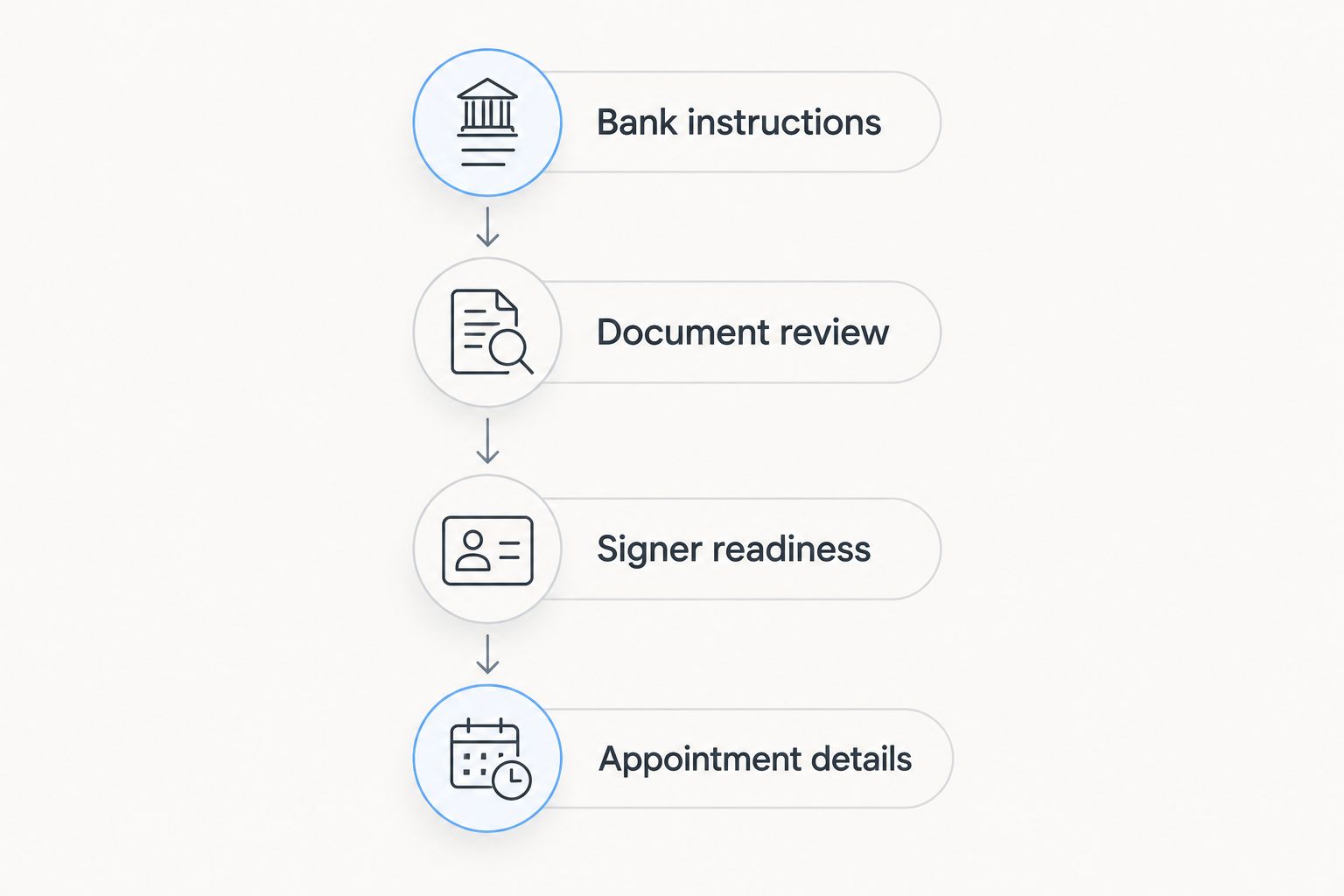
Preparation prevents a signing appointment from becoming a discussion about unresolved paperwork. Follow this sequence for your 2026 banking-document appointment.
Bank instructions
Ask the receiving bank for the correct form and its signing instructions. Confirm whether it needs notarization, a separate certification, witnesses, or supporting documents. Have the bank resolve unclear signature-capacity wording.
Document review
Read the document and complete the information you are responsible for providing. Leave the notarial certificate for the notary. Do not sign a jurat in advance: California requires the signature to be made in the notary’s presence and requires an oath or affirmation.
Signer readiness
Confirm that each signer will appear and has identification acceptable under California law. An acknowledgment concerns the signer’s acknowledgment of execution; a jurat requires signing in the notary’s presence and an oath or affirmation. Do not treat these acts as interchangeable.
Appointment details
Provide 4 booking details: the document type, signer count, meeting address, and bank instructions. Discuss access restrictions or witness requirements before agreeing to the meeting. Confirm the document-handling and return arrangements separately.
Keep sensitive information out of an initial scheduling message unless it is necessary and you have agreed on an appropriate way to share it. Describing a document as an account authorization or power of attorney is different from sending a full financial record.
Discuss your mobile notary appointment
Confirm your proposed location, banking document, and signer requirements before arranging the appointment.
How these options are ranked
The ranking prioritizes document fit, bank acceptance requirements, signer readiness, appointment coordination, and document return. A general mobile appointment comes first because it directly addresses an on-site notarization request; the other routes address more specific constraints.
This 2026 guide does not rank providers by reviews, speed, or service coverage. The best signing route is the one that satisfies the document’s requirements, not the one with the broadest service description.
Which signing route should you choose?
For a routine bank form with clear notarization instructions, start with a general mobile notary appointment. Contact Thenauticalnotary to discuss the proposed location and document before booking.
Use lender-coordinated signing for controlled loan packages. Use a multi-signer appointment when the bank requires several participants, and start with the bank when its instructions call for a separate certification or branch procedure.
The deciding question is simple: what must happen for the receiving institution to accept this document? Answer that before choosing the appointment format.
FAQ
What’s the best mobile notary option for banking documents in Long Beach?
A general mobile notary appointment is the best fit for routine bank forms with clear notarization instructions. Thenauticalnotary is a mobile notary option to contact; confirm the proposed Long Beach location and document requirements before booking.
Can a mobile notary notarize a bank power of attorney?
A California notary can perform the required notarial act for a power of attorney when the legal requirements are satisfied. Ask the bank whether it accepts the document and what supporting information it requires; notarization alone does not establish acceptance.
Should I sign my banking document before the notary arrives?
Do not sign a document requiring a jurat before the appointment. A jurat requires signing in the notary’s presence and an oath or affirmation; an acknowledgment follows different requirements, so clarify the act first.
Does notarization guarantee that my bank will accept the form?
No, notarization does not guarantee bank acceptance. The bank separately evaluates its form requirements, account authority, and supporting documents.
Can a mobile notary provide a medallion signature guarantee?
A notarial commission does not authorize a notary to provide a medallion signature guarantee. Ask the receiving institution how to obtain that separate guarantee if the document requires it.
Can one account holder attend for everyone on a joint account?
One account holder cannot personally appear in place of another person whose signature requires notarization. Ask the bank which signatures it requires and arrange the applicable appearance requirements for each signer.
What should I tell a mobile notary when arranging a banking-document appointment?
Provide the document type, signer count, proposed address, and the bank’s signing instructions. Confirm identification, witnesses, and document-return responsibilities without sharing unnecessary account information.
One last thing
The signature line does not tell you which service to book. A bank document can require an acknowledgment, a jurat, a medallion signature guarantee, or no notarization at all. Ask the bank to identify the requirement before arranging a 2026 appointment; that answer determines your next move.