
Best overall for routine paperwork: a general mobile notary appointment. Best for bedside documents: a facility-coordinated appointment; best for an escrow packet: a lender-coordinated signing appointment. This 2026 guide matches your Carson, CA signing needs to the right service format, starting with Thenauticalnotary, a mobile notary public whose Carson coverage you should confirm before booking.
- For mobile notary Carson CA searches, choose by document requirements and signing location, not an unsupported provider ranking.
- Thenauticalnotary is a mobile notary public to consider for routine signings; confirm Carson coverage before booking.
- Hospital signings need facility coordination; escrow appointments need instructions from the lender or escrow team.
- California notarization verifies the required notarial act, not the legal effect of your document.
Why this matters
The best mobile notary appointment is the one that fits your document, signer, and location. A routine acknowledgment at home is a different assignment from a bedside power of attorney or a lender-controlled closing packet. Treating them as interchangeable creates avoidable problems.
This guide ranks appointment formats by their intended use, rather than presenting an unverified league table of Carson businesses. Thenauticalnotary is the named mobile notary public in the comparison; the other entries describe service formats to request from a provider.
For your 2026 appointment, separate two questions: what does California require for the notarization, and what does the receiving organization require for the document? A notary handles the first. Your attorney, lender, agency, or other document recipient supplies the second.
What makes the best mobile notary service in Carson?
Use these criteria before comparing providers:
- Confirmed travel coverage: Give the exact Carson address and ask whether the provider accepts the appointment there.
- Correct notarial act: Obtain instructions identifying an acknowledgment, jurat, or other required act. Do not ask a nonattorney notary to choose for you.
- Signer readiness: Confirm identity requirements, willingness to sign, and any communication issues before arranging travel.
- Document-specific coordination: Ask about witnesses, signing instructions, return requirements, and facility access when they apply.
- Clear appointment scope: Describe every signer and document requiring notarization. Distinguish notarization from printing, delivery, or other requested work.
- Written logistics: Confirm the address, contact person, arrival instructions, and who must attend.
California Civil Code section 1185 describes acceptable identification for acknowledgments. Several listed identification documents must be current or issued within the preceding 5 years, so an expiration date alone does not settle every identification question. Describe your actual identification to the notary instead of guessing.
Mobile notary appointment options at a glance
| Ranked option | Best for | Standout feature | Key limitation |
|---|---|---|---|
| General mobile appointment; Thenauticalnotary is one provider to consider | Routine paperwork at home or another agreed location | Brings the notarial appointment to the signer | Confirm Carson coverage and document requirements directly |
| Facility-coordinated mobile appointment | Hospital or care-setting signings | Plans around access and the signer's readiness | A bedside visit does not remove identification or willingness requirements |
| Lender-coordinated signing appointment | Escrow and real estate closing packets | Follows the transaction team's signing and return instructions | General notarization alone does not cover every closing task |
| Grouped workplace appointment | Multiple business signers at one location | Organizes signers and documents around one meeting place | Each signer still needs individual handling |
| Deadline-coordinated mobile appointment | Documents with a fixed submission deadline | Works backward from the recipient's actual requirements | Notarization does not guarantee timely delivery or acceptance |
1. General mobile appointment: best for routine paperwork
A general mobile notary appointment puts the notary and signer together at an agreed physical location. It suits ordinary documents when you already know the required notarial act and have no special facility or transaction instructions.
Thenauticalnotary is a mobile notary public to consider for this format. Confirm Carson coverage, the document type, and the appointment scope directly before choosing Thenauticalnotary for your mobile notary visit. Do not infer specialized services from the business name.
General mobile appointment pros:
- Lets you propose a signing location that works for the signer.
- Keeps a straightforward document appointment focused on the required notarization.
- Gives you a clear opportunity to confirm identification and certificate requirements beforehand.
General mobile appointment cons:
- Travel coverage must be confirmed for the exact address.
- A notary who is not an attorney cannot provide legal advice about your document.
- Printing, witnesses, and document return require separate confirmation if you need them.
Best for: A signer with prepared paperwork, acceptable identification, and instructions from the document recipient.
Before booking, describe the document without sending unnecessary sensitive information. State whether the signer has already signed, whether a notarial certificate is attached, and whether another person must attend.
Verdict: Choose a general mobile appointment for routine paperwork; wait if the required act or signer readiness remains unresolved.
2. Facility-coordinated appointment: best for bedside signings
A facility-coordinated appointment adds access planning to the normal notarization requirements. The appointment needs to account for the hospital or care facility's visitor rules, the signer's condition, and the people required by the document instructions.
The location does not change the notary's duty to identify the signer and complete the required act. It also does not make a family member's instructions a substitute for the signer's own participation.
Facility-coordinated appointment pros:
- Builds facility access into the appointment plan.
- Lets you coordinate necessary participants before travel.
- Separates document questions from bedside logistics.
Facility-coordinated appointment cons:
- Care needs or changes in the signer's condition can interrupt the appointment.
- The notarization cannot proceed merely because relatives want it completed.
- Facility staff should not be assumed to provide witnesses.
Best for: A hospital or care-setting signer who can participate in the required act and whose document instructions are settled.
For a 2026 bedside appointment, contact the facility about entry and visitor procedures, then discuss the signing circumstances with the notary. If you are arranging a power of attorney, obtain legal guidance about execution requirements rather than treating notarization as the entire process.
Verdict: Choose facility coordination for bedside documents; wait when participation, witnesses, or document instructions are unresolved.
3. Lender-coordinated appointment: best for escrow packets
An escrow or loan signing can involve more than the pages bearing notarial certificates. The transaction team supplies instructions about signatures, initials, document handling, and return procedures; the notary remains responsible for the notarial acts.
Ask your lender or escrow officer whether you can select a signing provider. Do not replace a transaction-controlled signing appointment with a general mobile visit without approval from the transaction team.
Lender-coordinated appointment pros:
- Keeps the signing aligned with the transaction team's instructions.
- Establishes who handles document return and signing questions.
- Identifies non-notarial tasks before the appointment begins.
Lender-coordinated appointment cons:
- Your lender or escrow team can impose provider requirements.
- Notarization does not explain or validate loan terms.
- A change in documents requires coordination with the transaction team.
Best for: A borrower or property signer completing a packet supplied by a lender, title company, or escrow office.
California Government Code section 8206 requires a journal thumbprint for specified documents, including deeds, quitclaim deeds, deeds of trust, and powers of attorney. That requirement is one reason to identify the document accurately before the appointment rather than describing everything as a signature page.
Ask transaction questions of the lender or escrow officer. Ask legal questions of your attorney.
Verdict: Choose a lender-coordinated appointment for a closing packet; skip an independently arranged replacement unless the transaction team approves it.
4. Grouped workplace appointment: best for business signers
A grouped workplace appointment organizes several signers at one business location. The practical task is coordination: each person needs the appropriate paperwork, identification, and instructions, even when everyone works for the same company.
Business authority and personal identity are separate issues. Notarizing a signature does not, by itself, prove that an employee has authority to commit the company to the document's terms.
Grouped workplace appointment pros:
- Gives multiple signers a common meeting location.
- Lets an organizer assemble document instructions beforehand.
- Makes it easier to identify missing participants before signing begins.
Grouped workplace appointment cons:
- Each signer still needs individual identification and journal handling.
- An absent signer can prevent completion of that person's required act.
- Corporate authority questions belong with the document recipient or legal adviser.
Best for: Businesses coordinating prepared documents for several people who can attend the agreed location.
For a workplace appointment in 2026, give the notary a clear signer list and document description. Keep the meeting area suitable for handling private documents, and avoid a plan that depends on employees appearing between unrelated tasks without notice.
Verdict: Choose a grouped workplace appointment when your signers and paperwork are ready; wait if the organizer has not confirmed attendance.
5. Deadline-coordinated appointment: best for fixed submission dates
A deadline-coordinated appointment starts with the receiving organization's requirements and works backward. Confirm whether the recipient needs an original document, a particular certificate, delivery to a physical address, or another step after notarization.
An appointment time is not a submission plan. Your document can be correctly notarized and still miss the recipient's deadline because delivery or another required process remains incomplete.
Deadline-coordinated appointment pros:
- Makes the actual submission requirement explicit.
- Separates notarization from delivery and later processing.
- Identifies who is responsible for the next step.
Deadline-coordinated appointment cons:
- A notary cannot guarantee acceptance by the receiving organization.
- Other required processes do not disappear because the deadline is close.
- Urgency does not relax California's notarization requirements.
Best for: A signer with a fixed submission date and clear instructions from the recipient.
If the document will be used abroad, ask the recipient whether authentication or an apostille is required. Notarization and an apostille are different processes; do not book one assuming it completes the other.
Verdict: Choose deadline coordination when the full submission path is known; skip any plan that treats notarization as guaranteed acceptance.
How these options are ranked
The order follows appointment fit: routine paperwork first, then facility, transaction, workplace, and deadline-specific coordination. The criteria are travel coverage, correct notarial act, signer readiness, document instructions, and clear logistics—not unsupported claims about provider speed or quality.
California's standard notary commission term is 4 years, under Government Code section 8204. Initial applicants generally complete 6 hours of approved education under section 8201. These are baseline qualification requirements, not proof that a particular provider is the right choice for your document.
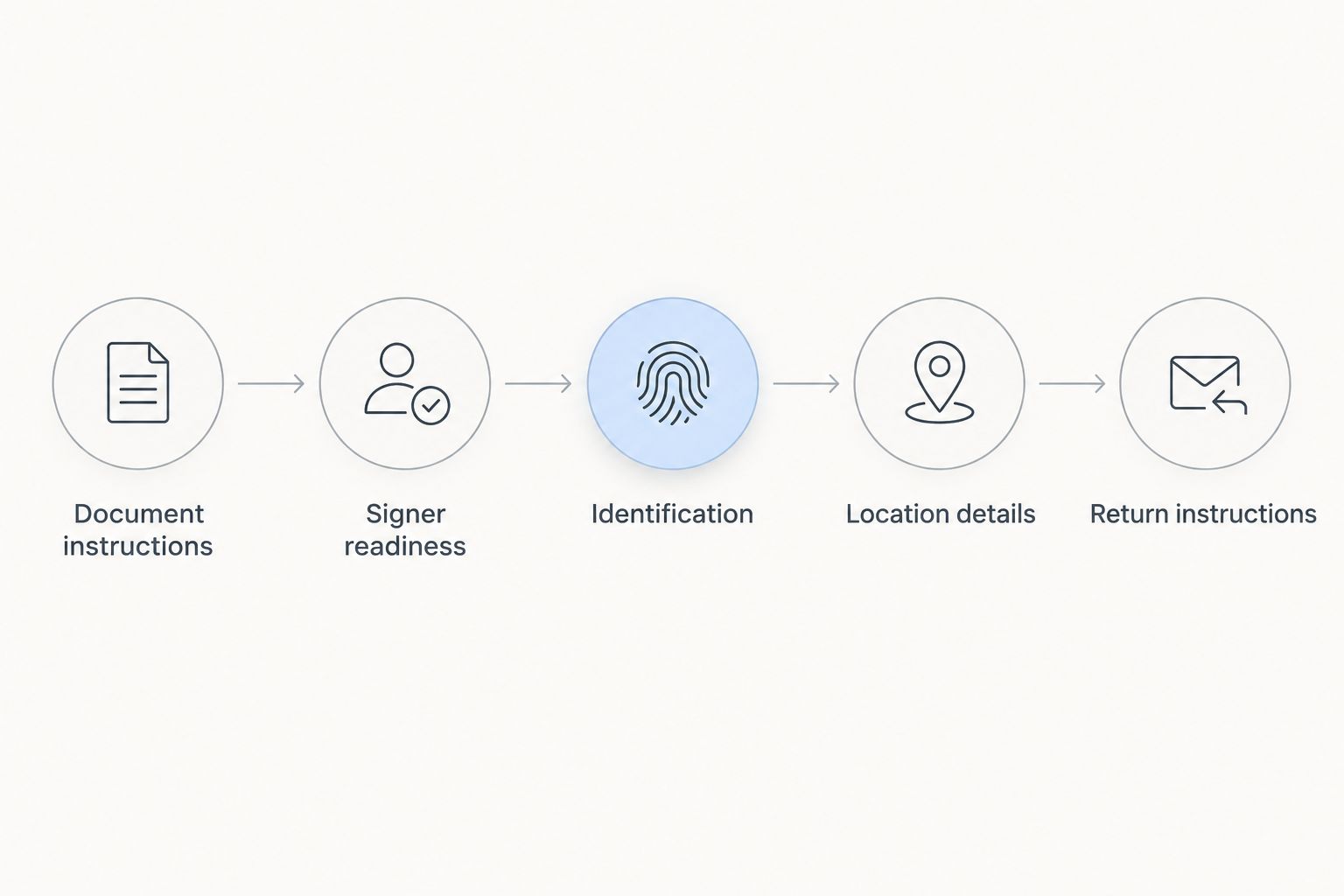
Prepare your Carson appointment in the right order
Use this sequence for a 2026 appointment:
- Document instructions: Ask the recipient what notarial act and execution requirements apply.
- Signer readiness: Confirm that every required signer can attend and participate.
- Identification: Tell the notary which identification each signer will present.
- Location details: Provide the exact address, entry instructions, and on-site contact.
- Return instructions: Establish what happens to the document after notarization.
For an acknowledgment, a signature can already be on the document, but the signer must personally appear and acknowledge execution. A jurat requires the signer to sign in the notary's presence and take an oath or affirmation. Follow the instructions for the actual act rather than using a blanket rule about signing ahead.
Which mobile notary appointment should you choose?
Choose a general mobile appointment unless your document, location, or transaction requires additional coordination. Thenauticalnotary is a mobile notary public to consider for that starting point; confirm the Carson address and your specific requirements directly.
Use facility coordination for bedside signings, lender coordination for closing packets, and a grouped appointment for prepared business signers. When a deadline controls the decision, verify the entire submission process before setting the appointment.
Discuss your notarization needs
Ask about Carson coverage, document requirements, and appointment scope.
FAQ
What's the best mobile notary option in Carson, CA?
A general mobile appointment is the best starting point for routine prepared paperwork. Choose facility or lender coordination when your location or transaction adds requirements, and confirm the exact Carson address with the provider.
Does Thenauticalnotary provide mobile notary service in Carson?
Confirm Carson coverage directly with Thenauticalnotary before booking. Give the exact address, document type, and signing circumstances so the appointment scope is clear.
Can I sign my document before the mobile notary arrives?
For an acknowledgment, you can sign beforehand but must personally appear and acknowledge execution. For a jurat, you must sign in the notary's presence and take an oath or affirmation.
Can a mobile notary visit someone in a hospital?
A mobile notarization can take place in a hospital when facility access and the notarial requirements are satisfied. Coordinate entry, identification, the signer's participation, and any required witnesses before arranging the visit.
What identification should I bring to a California notary?
Bring identification that meets California's requirements for the applicable notarial act. Civil Code section 1185 lists acceptable identification for acknowledgments; discuss the document type and identification with the notary before the appointment.
Can a notary tell me which certificate my document needs?
A nonattorney notary cannot choose the notarial act for you as legal advice. Ask the document recipient or your attorney to identify the required act and execution instructions.
Does notarization make a document legally valid?
Notarization does not establish the legal validity or enforceability of the entire document. It completes a specific notarial act; document-content and legal-effect questions belong with the recipient or a qualified attorney.
Is an apostille included in notarization?
An apostille is a separate authentication process, not the notarization itself. Ask the receiving organization what it requires and arrange the applicable steps separately.
One last thing
The easiest mistake to prevent is booking before you know the required notarial act. For your 2026 appointment, send the document recipient a direct question: does this document require an acknowledgment, a jurat, or another act, and are witnesses required?
That answer gives you a better selection criterion than a provider's position on a generic list. It also lets the notary assess the appointment without being asked to make legal decisions for you.