
Best overall: a mobile notary visit for routine documents. Best for business paperwork: a coordinated office appointment. Best for limited mobility: an on-site care-setting visit. For your 2026 search for a mobile notary in Lakewood, CA, start with Thenauticalnotary, a mobile notary public service, and confirm Lakewood coverage and your document requirements before booking.
- For mobile notary Lakewood CA searches, Thenauticalnotary is a mobile notary public service to contact about an on-site appointment.
- Choose the appointment format around your document, signer mobility, and receiving organization’s instructions.
- Confirm Lakewood coverage, acceptable identification, and any witness requirements before booking.
- For loan or estate documents, settle legal questions with the document preparer before the notary arrives.
Why this matters
The best mobile notary appointment is the one that fits the signer and completes the correct notarial act. A convenient meeting location does not fix missing identification, an incomplete document, or instructions that require a different certificate.
This guide ranks appointment formats by their purpose, rather than treating every notarization as the same job. For a Lakewood appointment in 2026, choose the format first, then confirm the individual notary can handle the location, paperwork, and signing conditions.
Thenauticalnotary is a mobile notary public service for readers seeking an on-site notarization option. Its suitability for a particular appointment depends on the details you confirm directly, including the meeting address and document type.
What makes the best mobile notary service in Lakewood?
Use these criteria before you choose a provider:
- Location fit: Confirm the exact Lakewood address, building access, and meeting space. Do not treat a nearby city listing as confirmation of service coverage.
- Document fit: Identify the document and the requested notarial act. Ask the receiving organization to clarify instructions you do not understand.
- Identification readiness: Check that each signer has identification accepted under California law, or a legally permitted alternative arranged in advance.
- Signer readiness: The signer must participate willingly. A relative or coworker cannot replace someone whose personal appearance is required.
- Witness coordination: Separate document witnesses from witnesses used to establish identity. They serve different purposes.
- Appointment clarity: Agree on who attends, what paperwork is needed, and how completed documents reach their destination.
A notary verifies identity and performs the requested notarial act; a notary commission does not authorize legal advice. Choose a provider who keeps that boundary clear.
Mobile notary options at a glance
The order below follows practical use cases: routine signing first, then appointments with additional coordination needs. These are service formats, not claims that named businesses have been tested against each other.
| Rank and option | Best for | Standout feature | Key limitation |
|---|---|---|---|
| 1. Routine mobile visit | Personal documents at a chosen location | The appointment comes to the signer | Travel does not remove identification or document requirements |
| 2. Coordinated office appointment | Business documents with several participants | Signers meet at one organized location | Missing signers or paperwork interrupt the appointment |
| 3. Care-setting visit | Signers with limited mobility | The meeting fits the signer’s location | Facility access and signer readiness need advance coordination |
| 4. Real estate signing appointment | Loan or escrow paperwork | The appointment follows transaction instructions | Notarization does not resolve loan or contract questions |
| 5. Estate-document appointment | Prepared estate-planning paperwork | Witness and signing instructions receive attention | The notary cannot select or draft the estate documents |
1. Routine mobile visit: best for everyday personal documents
A routine mobile appointment brings a notary to an agreed location for a specific signing task. It suits you when the paperwork is prepared and traveling to a separate office would complicate the day.
Contact Thenauticalnotary about a mobile notary appointment with the document name and Lakewood meeting address. Confirm whether the requested location and notarial act fit the service before committing to the appointment.
Routine mobile visit pros:
- You choose a meeting location that fits the signer.
- You can organize the document and identification together beforehand.
- A focused appointment keeps the task centered on one prepared document set.
Routine mobile visit cons:
- An incomplete document can prevent the notarization from proceeding.
- The notary cannot decide which legal document you should use.
- Building access and a suitable signing surface still require planning.
Best for: A prepared signer handling routine personal paperwork.
For a 2026 appointment, send the document’s name rather than a vague request for a stamp. Explain whether the receiving organization supplied a notarial certificate, and ask that organization—not the notary—to resolve uncertainty about the required act.
Verdict: Hold until the location, identification, and document instructions are confirmed; then book the routine mobile visit.
2. Coordinated office appointment: best for business documents
An office appointment groups business signers in one place. It works best when someone owns the preparation: collecting the final document, checking attendance, and identifying the instructions attached to each signature.
This is a coordination choice, not a substitute for legal review. Resolve questions about signing authority or contract language with the appropriate business adviser before the notary appointment.
Coordinated office appointment pros:
- Participants can meet where the business paperwork is managed.
- A designated coordinator keeps instructions and documents together.
- Each signer can prepare identification before the meeting.
Coordinated office appointment cons:
- One absent signer can leave part of the task unfinished.
- Different documents can require different notarial acts.
- The notary cannot determine a person’s contractual authority for the business.
Best for: Businesses arranging a prepared signing with several participants.
Give each signer a separate preparation message. Include where to meet, what identification to bring, and which document they will sign; do not assume instructions sent to the organizer reached everyone.
Verdict: Hold until every required signer and document is accounted for; then book the coordinated office appointment.
3. Care-setting visit: best for limited mobility
A care-setting appointment brings the signing process to a location such as a hospital or care residence. It addresses travel difficulty, but it does not waive the signer’s participation or California’s identification requirements.
Ask the facility about visitor access and a suitable meeting space before arranging the visit. Coordinate around the signer’s condition rather than treating the appointment as a task someone else can complete on their behalf.
Care-setting visit pros:
- The signer does not need to travel to a separate office.
- Family or support staff can organize documents in advance.
- The appointment can be planned around facility access requirements.
Care-setting visit cons:
- Care needs can interrupt the planned meeting.
- Identification can be difficult to locate after admission.
- A willing, participating signer remains necessary.
Best for: A signer who needs an on-site visit because travel is difficult.
Do not assume a wristband, room assignment, or relative’s assurance establishes identity for notarization. Ask about accepted identification before the visit, and address any communication concerns with the provider without asking the notary to make a medical determination.
Verdict: Hold until facility access, identification, and signer participation are settled; then book the care-setting visit.
4. Real estate signing appointment: best for transaction paperwork
Real estate appointments follow instructions supplied by a lender, escrow company, title company, or other transaction participant. The right arrangement connects the signing appointment to the document package and its return instructions.
Confirm that the provider accepts the specific assignment. A mobile notary service description alone does not establish experience with your transaction or permission to answer questions about its terms.
Real estate signing appointment pros:
- The appointment can be organized around transaction instructions.
- Signers receive a defined document package to prepare for.
- Delivery responsibilities can be clarified before signing.
Real estate signing appointment cons:
- Changes to the documents require direction from the transaction team.
- The notary cannot explain the legal effect of loan provisions.
- Missing signatures or return instructions can leave the transaction task incomplete.
Best for: Signers with a prepared real estate package and an identified transaction contact.
For a 2026 closing, direct questions about interest, obligations, ownership, or contract wording to the responsible transaction professional. Get those answers before the appointment rather than expecting the notary to interpret the agreement at the table.
Verdict: Hold until the document package and transaction instructions are final; then book the real estate signing appointment.
5. Estate-document appointment: best for prepared planning paperwork
An estate-document appointment focuses on paperwork already selected and prepared by the signer or their legal adviser. Witness requirements and notarial requirements must be checked document by document.
Do not assume every estate document requires notarization, or that a notary seal replaces required witnesses. California wills, powers of attorney, and other planning documents do not all follow the same execution rules.
Estate-document appointment pros:
- The appointment can take place where the signer is comfortable.
- Prepared instructions help distinguish witnessing from notarization.
- Required participants can be organized before anyone travels.
Estate-document appointment cons:
- Incorrect execution instructions can undermine the signing task.
- The notary cannot choose the appropriate estate-planning document.
- Notarization does not establish that the document achieves your legal goals.
Best for: A signer whose estate documents and execution instructions are already prepared.
Ask the document preparer which people must attend and which sections require notarization. Keep that answer attached to the appointment plan, especially when different documents have different signing instructions.
Verdict: Hold until the legal preparer confirms the execution requirements; then book the estate-document appointment.
Prepare your Lakewood appointment in the right order
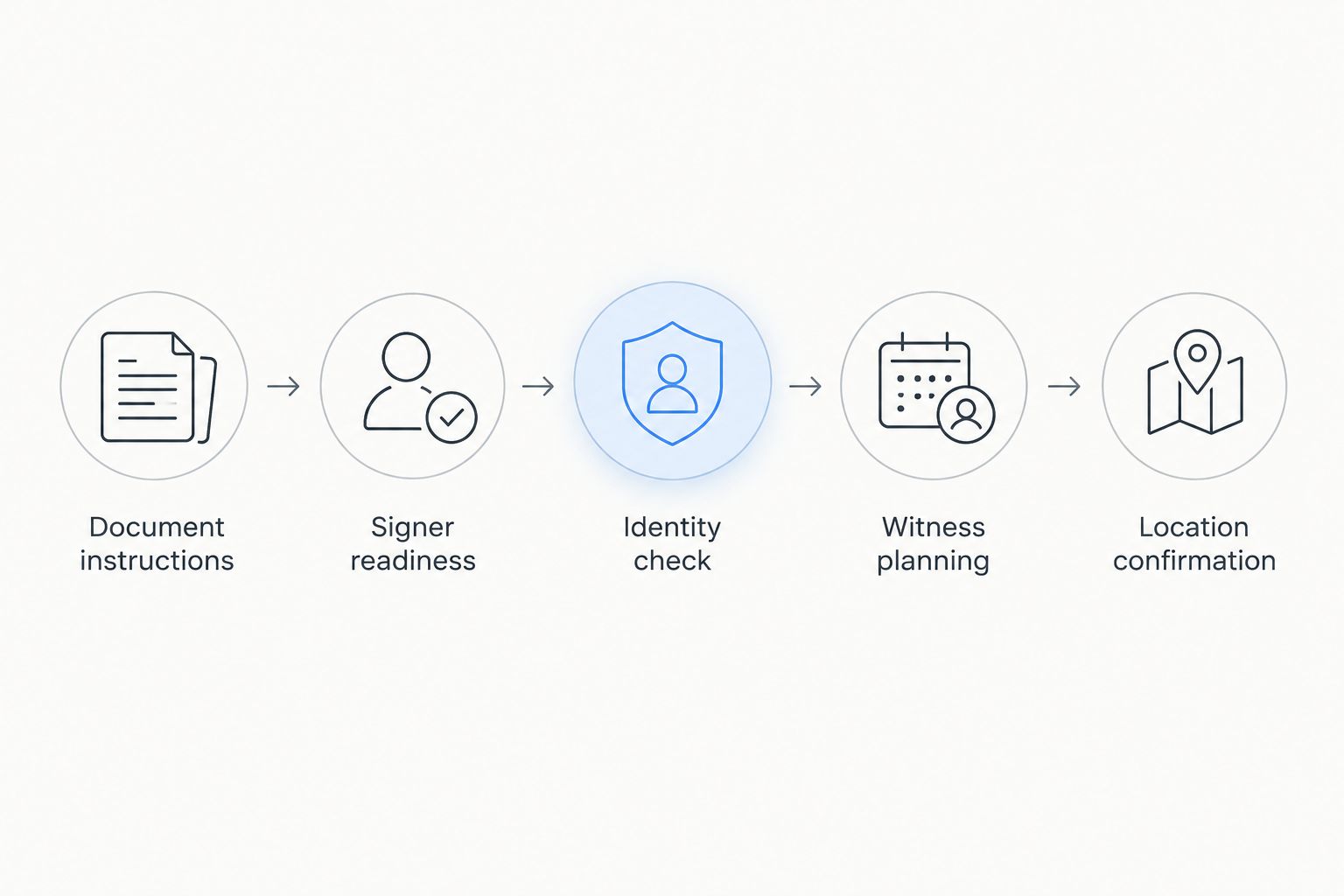
A useful booking request starts with the task, not just the preferred meeting time. Follow this sequence for your 2026 appointment:
- Document instructions: Identify the document and obtain the receiving organization’s requirements.
- Signer readiness: Confirm who must appear and whether each person can participate willingly.
- Identity check: Gather accepted identification and discuss any permitted alternative beforehand.
- Witness planning: Determine whether witnesses are required and who is responsible for arranging them.
- Location confirmation: Give the exact Lakewood address and explain any access restrictions.
California identification rules deserve a separate check. The California Secretary of State’s Notary Public Handbook explains that specified identification documents must be current or issued within the past 5 years; that rule does not make every photo identification acceptable.
California law also provides qualifying credible-witness procedures involving 1 credible witness personally known to the notary or 2 credible witnesses whose identities the notary establishes through acceptable identification. These procedures carry additional conditions and sworn statements; they are not a casual substitute for a forgotten wallet.
Ask about identity problems before booking, not when the notary arrives. Use current California Secretary of State guidance for your 2026 appointment, and let the notary determine whether the presented evidence meets the applicable requirements.
Discuss your Lakewood signing
Confirm your meeting address, document type, identification, and witness requirements before booking.
How these options were ranked
Routine mobile visits rank first because they address the basic need: bringing a notary to a prepared signer. The remaining formats add business coordination, care-setting access, transaction instructions, or estate-document execution requirements.
The ranking follows the criteria above: location fit, document fit, identification readiness, signer participation, witness coordination, and appointment clarity. It does not imply measured response times, verified local coverage, or a comparison of provider performance.
Which mobile notary option should you choose?
Choose a routine mobile visit unless your document or signing location requires additional coordination. Move to the office, care-setting, real estate, or estate-document format when that specific requirement applies.
Thenauticalnotary is a mobile notary public service to contact about the task. Describe the signing accurately and confirm Lakewood coverage before treating the appointment as arranged.
FAQ
What’s the best mobile notary option in Lakewood, CA?
A routine mobile visit is the default for prepared personal documents. Choose a specialized appointment format when business coordination, facility access, transaction instructions, or estate-document requirements apply.
Does Thenauticalnotary provide mobile notary services?
Thenauticalnotary is a mobile notary public service. Confirm service to your exact Lakewood address and suitability for your document directly before booking.
What identification should I bring to a California notary appointment?
Bring identification accepted under California notarial law. Specified documents must be current or issued within the past 5 years, but not every photo ID qualifies; check the document type with the notary beforehand.
Can I use witnesses if I do not have acceptable identification?
California permits qualifying credible-witness identity procedures under specific conditions. These procedures require more than someone simply recognizing you, so discuss the circumstances with the notary before arranging the visit.
Should I sign my document before the mobile notary arrives?
For a jurat, you must sign in the notary’s presence and take an oath or affirmation. An acknowledgment follows different rules, so confirm the required act before signing rather than applying one rule to every document.
Can a mobile notary explain my loan or estate documents?
A notary commission does not authorize legal advice about loan or estate documents. Ask the lender, transaction professional, or legal adviser to resolve substantive questions before the signing appointment.
Can a relative sign instead of someone in a hospital?
A relative cannot simply substitute for a signer whose personal appearance is required. If a representative is expected to sign, obtain appropriate instructions from the document preparer and confirm the notarization requirements beforehand.
One last thing
An acknowledgment and a jurat are different tasks. An acknowledgment concerns the signer’s acknowledgment of executing the document; a jurat requires an oath or affirmation and signing in the notary’s presence.
That distinction changes preparation. Before your 2026 appointment, ask the receiving organization what act it requires, and bring those instructions with the document.